Every style we carry, and the material each one was built for
Wall count, flap style and closure are three independent decisions, and getting any of them wrong shows up as a failed box on a forklift. Here is the whole catalogue with the reasoning attached.
Ask about box types & styles
Tell us what you have or what you need. A real person in Houston reads every one of these — usually within a couple of hours during dock time.

At a glance
- 2-wall
- 1,000–1,200 lb · light bulky material
- 3-wall (tri-wall)
- 1,800–2,000 lb · the workhorse
- 4-wall
- 2,500–3,000 lb · dense material, long storage
- 5-wall
- 4,000 lb+ · aggregate, powders, foundry
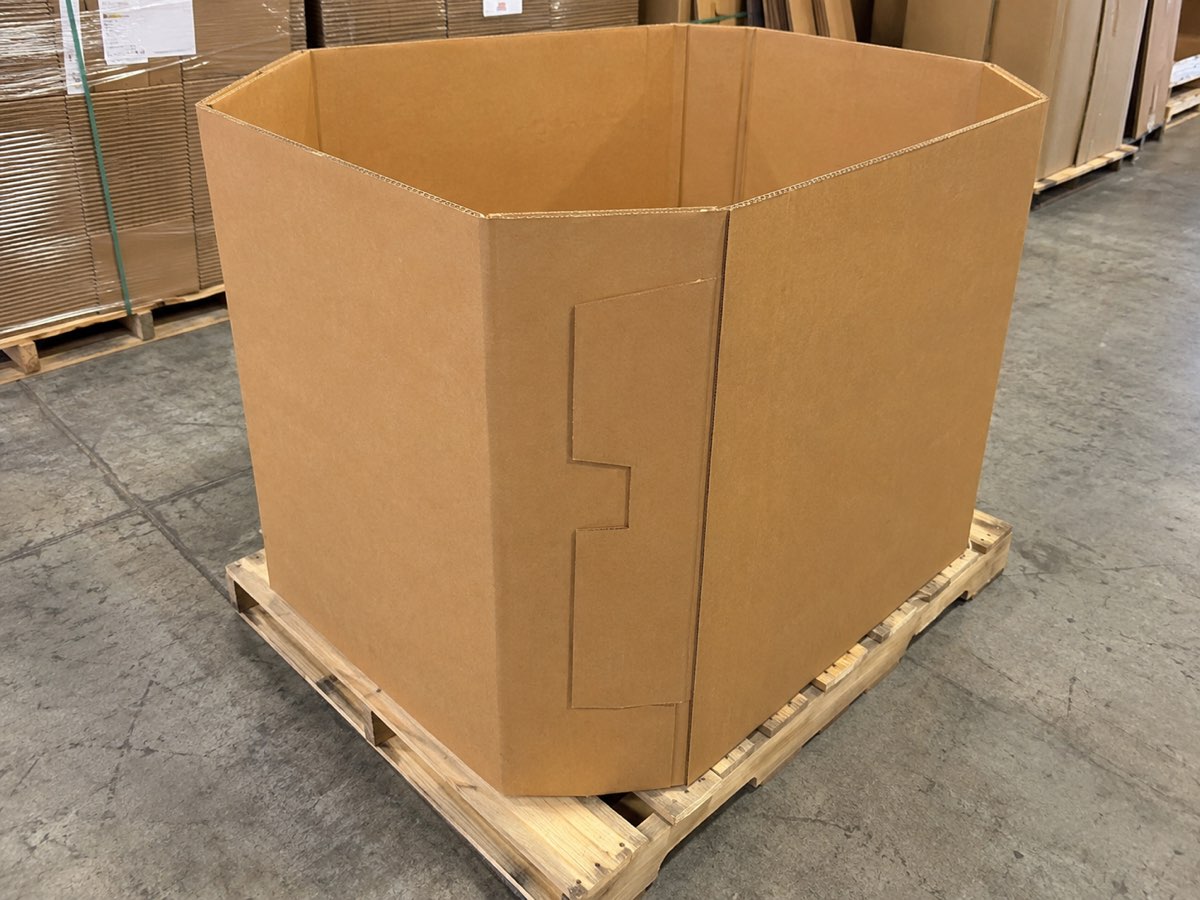
- Octagon
- Tri-wall, 8-sided · free-flowing solids
- Sleeve + cap/base
- Fast fill and empty, easy to knock down
Axis one: wall count
The number of fluted layers. More flutes means more arches carrying load, roughly linear up to four walls. This is the decision driven purely by weight, stack height, storage duration and humidity.
| Wall count | Static load | Stack | Belongs with |
|---|---|---|---|
| 2-wall | 1,000–1,200 lb | 2 high | Textiles, foam, film, light plastics |
| 3-wall / tri-wall | 1,800–2,000 lb | 2–3 high | Most plastics, most recycling, general industrial |
| 4-wall | 2,500–3,000 lb | 3 high | E-scrap, metal, dense regrind, 6-month storage |
| 5-wall | 4,000 lb+ | 3–4 high | Aggregate, foundry sand, chemical powders |
Axis two: flap style
- RSC (regular slotted container) — flaps meet in the middle. The standard, the cheapest, adequate for most loads.
- FOL (full overlap) — flaps overlap completely, doubling board across the top and bottom. Worth it for heavy loads and rough handling.
- HSC (half-slotted container) — open top with a separate telescoping cap. Fastest to fill from above, best for automated filling.
- Sleeve — four walls, no top or bottom, used with a separate cap and base. Knocks down flattest, empties fastest.
Axis three: closure
Flaps folded and taped is the default. A telescoping lid over the outside of the walls gives better weather resistance and lets you stack without a pallet cap. A cap-and-base set with a sleeve is the fastest to assemble and the fastest to knock down, which matters enormously in a closed loop where somebody handles the box eight times a year.
Octagon bins are their own category
Eight sides distribute hoop stress rather than concentrating it in four corners. Free-flowing solids — resin, grain, powders, granules — behave like a fluid under vibration and push outward evenly. A square box concentrates that push in corners, which is precisely where a square box fails. Octagons cost more and ship at slightly lower density, and for the right material they are worth both.
Bulk bins, tote boxes, octabins, pallet boxes
All roughly the same object under different regional and industry names. We answer to all of them. Where terminology genuinely matters is inside your own purchasing system — pick one name, put the inside dimensions and wall count next to it, and stop having the conversation.
Box Types & Styles — common questions
Is tri-wall the same as 3-wall?
Yes. Tri-wall is the common trade term for three-ply corrugated board and it is the most common bulk box construction by a wide margin.
What is the difference between a gaylord box and a bulk bin?
Usually nothing — both mean a pallet-sized bulk container. 'Bulk bin' occasionally refers specifically to rigid plastic containers, so it is worth confirming which the other party means.
Which style is best for automated filling?
HSC with a separate telescoping cap. Open top, no flaps in the way of a fill head, and the cap goes on after.
Do you stock all of these?
Used stock covers RSC, FOL, HSC and octagon in common sizes. Sleeves and unusual geometries are typically new-build or fabricated.