Eight sides, because free-flowing solids push outward evenly
A square box concentrates outward pressure in four corners, which is exactly where square boxes fail. An octagon spreads it around eight faces. For anything that behaves like a fluid when it moves, that geometry is the whole ballgame.
Ask about octagon bins
Tell us what you have or what you need. A real person in Houston reads every one of these — usually within a couple of hours during dock time.
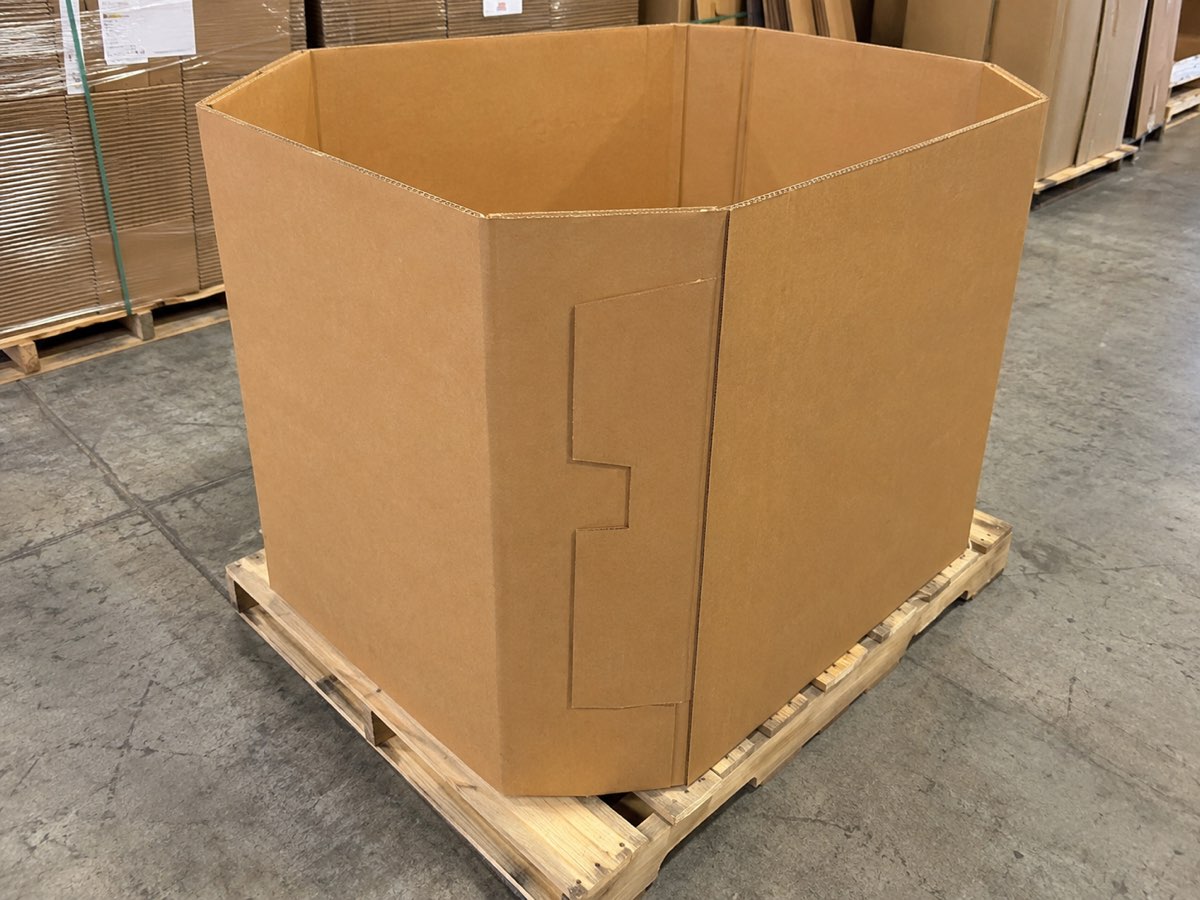
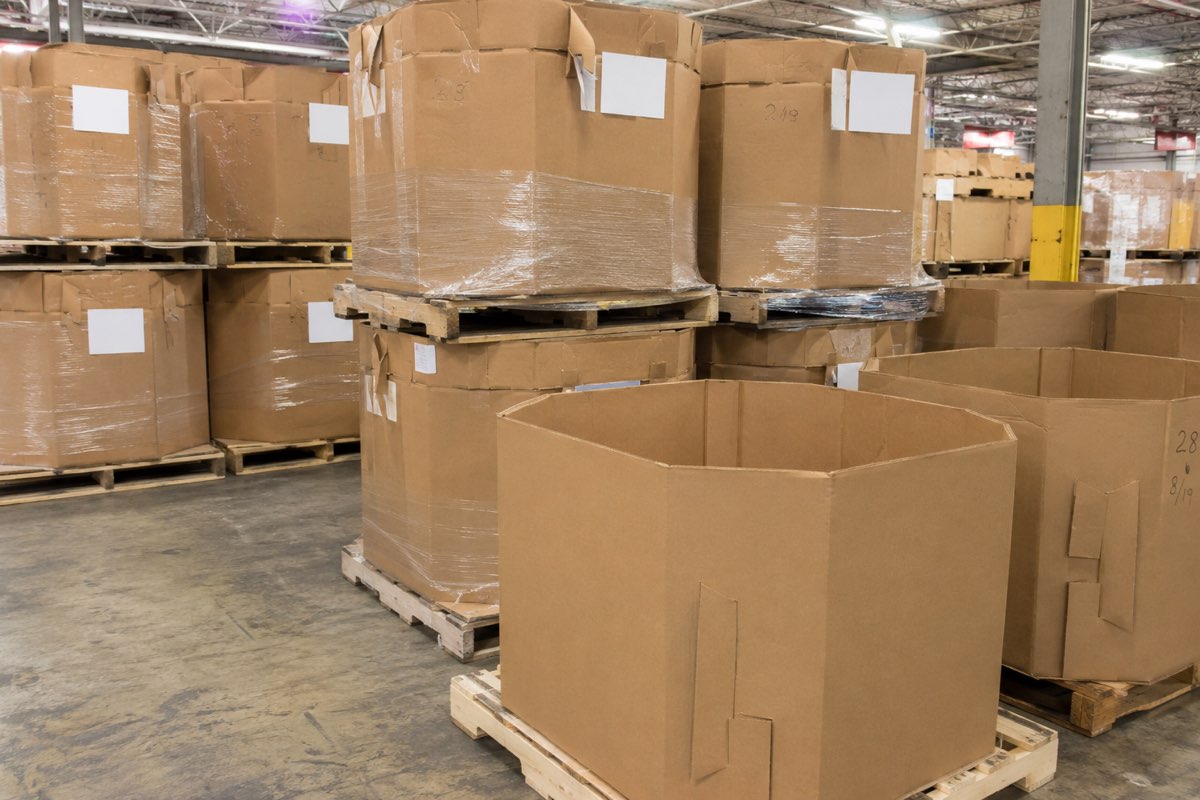
At a glance
- Typical size
- 48" × 40" footprint, 40" wall
- Construction
- Tri-wall octagon body
- Capacity
- 2,500 – 4,000 lb
- Volume
- ~44 cu ft
- Per 53′ trailer
- ~400 knocked down
- Common accessories
- Spouted liners, telescoping caps, pallet bases
The physics, briefly
Granular material under vibration behaves partly like a fluid: it exerts outward pressure on container walls proportional to depth. In a square container, that pressure concentrates at the corners, where two flat panels meet at 90 degrees and there is nothing to resist bending except the fold itself. Blow-outs happen at corners, essentially always.
An octagon replaces each 90-degree corner with two 135-degree bends. The load path is closer to a circle, the hoop stress distributes, and the container holds its shape through vibration that would round out a square box in a few hundred miles.
Where octagons earn their premium
- Resin pellets and granules — the highest-volume octagon application on the Gulf Coast.
- Grain, rice, nuts and dry agricultural products.
- Chemical powders and minerals, especially anything fine enough to migrate through a seam.
- Long transit — rail, intermodal, anything that vibrates for days.
- Loads discharged from the bottom through a spouted liner.
Where a square box is still the right call
- Anything that stays in a lump — textiles, parts, e-scrap, baled material.
- Hand-picking applications where reaching into a corner is useful.
- Tight freight budgets on short local moves where the vibration risk is minimal.
- Racking systems designed around a rectangular footprint.
Liners and discharge
Most octagon applications run a liner — anti-static for virgin resin, food-grade for edible product, spouted for bottom discharge. The liner is what actually contains fine material; the octagon contains the liner. Spec them together or you will end up with a container that holds shape beautifully around a bag that leaks.
Used octagons
We carry them, and they are one of the better values in used inventory because most arrive having carried a clean, dry, non-staining product exactly once. Grading is the same six points, with extra attention to whether the eight vertical folds have started to round — a rounded fold is the octagon equivalent of a soft corner.
Octagon Bins — common questions
Is an octabin the same as an octagon bin?
Yes. Octabin is the more common term in Europe and in the resin industry; octagon bin is more common in North American recycling.
Can octagon bins be stacked?
Yes, typically two to three high when properly aligned and capped. They stack better than square boxes because the load path is more even, but they are less tolerant of misalignment.
Do you stock liners?
Yes — anti-static, food-grade and spouted, in Houston, so you are not waiting on a Midwest shipment.
What pallet do they need?
A standard 48×40 GMA works for the common size. The octagon footprint inscribes within the rectangle, so there is no overhang concern.