A patch, a flap and fifteen minutes buys another two trips
About a fifth of the boxes that come back to us need something small before they can go out again. Doing that work is the difference between a box with three lives and a box with five.
Request a reconditioning quote
Tell us what you have or what you need. A real person in Houston reads every one of these — usually within a couple of hours during dock time.
What can be fixed, and what cannot
| Damage | Repairable? | Method |
|---|---|---|
| Clean cut in a wall | Yes | Glued corrugated patch, inside and out |
| Split or opened seam | Yes | Re-stapled or re-taped with reinforced box tape |
| Torn or missing flap | Yes | Replacement flap scored and attached |
| Crushed top edge | Sometimes | Cut down to a shorter wall height |
| Soft or rounded corner | No | Structural. Straight to the baler. |
| Bulged bottom | No | Flutes are crushed. It will fail loaded. |
| Tide line / water damage | No | Permanent strength loss even after drying. |
| Odour or residue | No | Transfers to your material. Scrap. |
Cut-downs: the most underrated service we offer
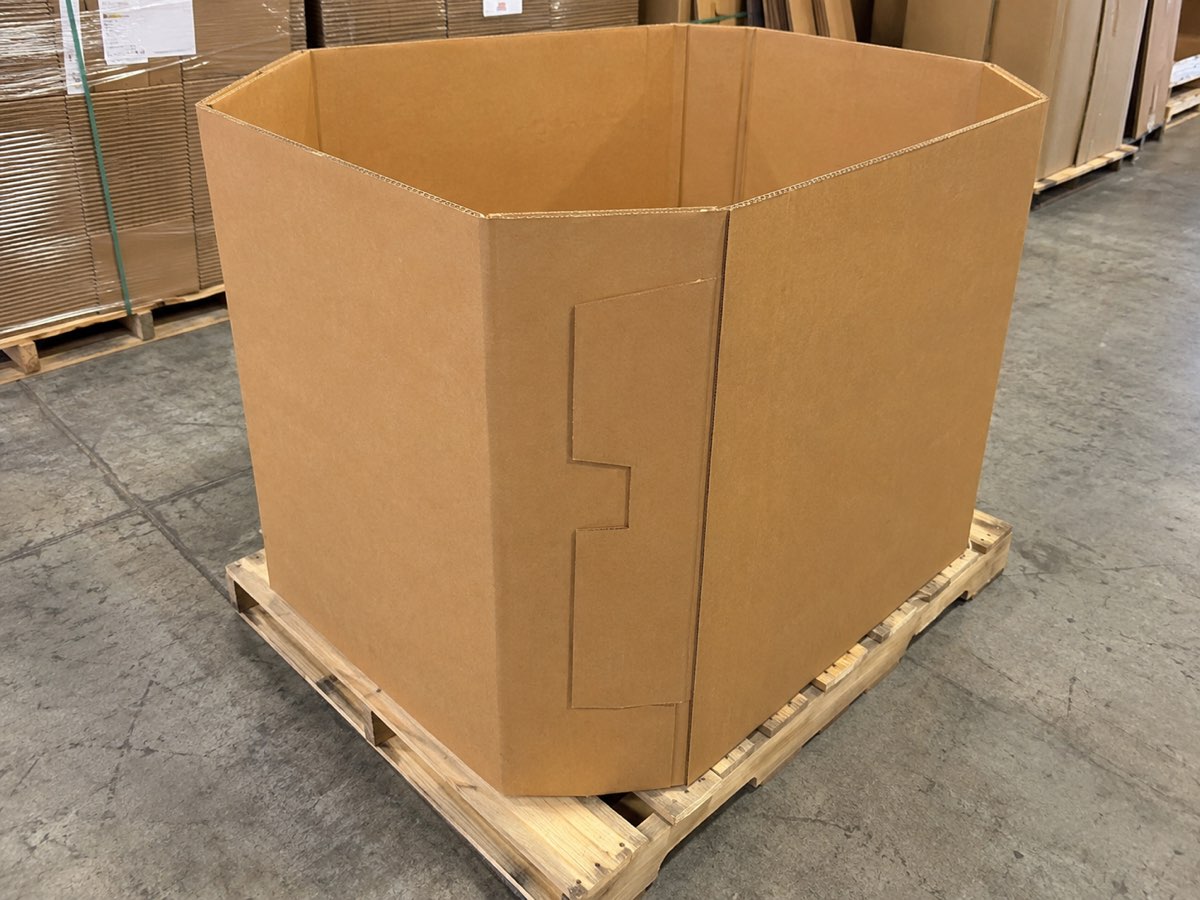
A 48×40×36 with a crushed top edge is not scrap — it is a 48×40×30 waiting to happen. We cut the damaged band off, re-score the flaps and it comes back into inventory as a shorter box with full structural integrity below the cut.
This works in the other direction too. If your material only ever fills a box to 24 inches, buying 36-inch boxes and cutting them down is frequently cheaper than sourcing 24-inch stock, and it uses boxes that would otherwise have been graded down.
Repair standards we hold to
- Patches are glued corrugated, applied inside and out, oriented so the flutes run with the wall. Tape alone holds nothing in compression.
- Seams are re-stapled where the original was stapled and taped where the original was glued — matching the original construction, not improvising.
- Every repaired box is stood up empty and re-inspected against the same six-point check as new intake.
- Repaired boxes are marked, so nobody downstream mistakes a Grade B for a Grade A.
On your floor or on ours
For closed-loop customers the repair path lives with us: boxes come back to the yard, get graded, get patched or baled, and re-enter your pool at their new grade. For high-volume generators we will train your team on the four repairs that matter and supply patch stock, which keeps boxes in service without a round trip.
How it runs, start to finish
Return or collect
Boxes come back on a scheduled route or on the truck that delivers your next order.
Six-point grade
Corners, bottom, walls, flaps, moisture, odour. Structural failures are pulled immediately.
Repair or cut down
Patch, re-seam, re-flap, or cut to a shorter wall height where the damage is confined to the top band.
Re-grade and mark
Repaired boxes get their honest new grade and a mark so nobody downstream is guessing.
Back into service
Into your pool or into our inventory, with the repair count on record.
Reconditioning — common questions
How many times can a box be repaired?
Two clean repairs is the practical ceiling for a box you still want to trust with weight. Past that it is a Grade C one-way container.
Is reconditioning cheaper than buying used?
For boxes already in your pool, almost always — you are paying for a patch instead of a box plus freight. For boxes you would have to ship to us and back, it depends entirely on distance.
Can you cut down boxes to a custom height?
Yes, in one-inch increments, though we will usually suggest a standard height so the lids and caps you already own still fit.
Do repaired boxes get sold as Grade A?
Never. A repair is a repair. One or two clean ones makes it a B.