Skip to content
GAYLORD BOXES TXHOUSTON · SINCE 2009
Tool · The house speciality

The Grade Decoder

Six questions. Out comes a wall count, a grade, a footprint and a wall height — plus the reasoning, so you can argue with it if you disagree.

Six questionsNo email requiredShows its working
How it works: the decoder calculates the load your bottom box actually carries — weight × (stack − 1), derated for storage creep and humidity — then maps that to a wall count. Grade comes from who sees the box, and shape comes from whether your material flows.
Request a quote

Prefer to just ask a person?

Tell us what you have or what you need. A real person in Houston reads every one of these — usually within a couple of hours during dock time.
US or Canada, 10 digits — area code first.

US state or Canadian province.

ZIP like 77073, or Canadian M5V 2T6.

Whole boxes. A rough number is fine.

No phone number required from us — we quote in writing so you have the numbers on paper. We never sell or share your details.

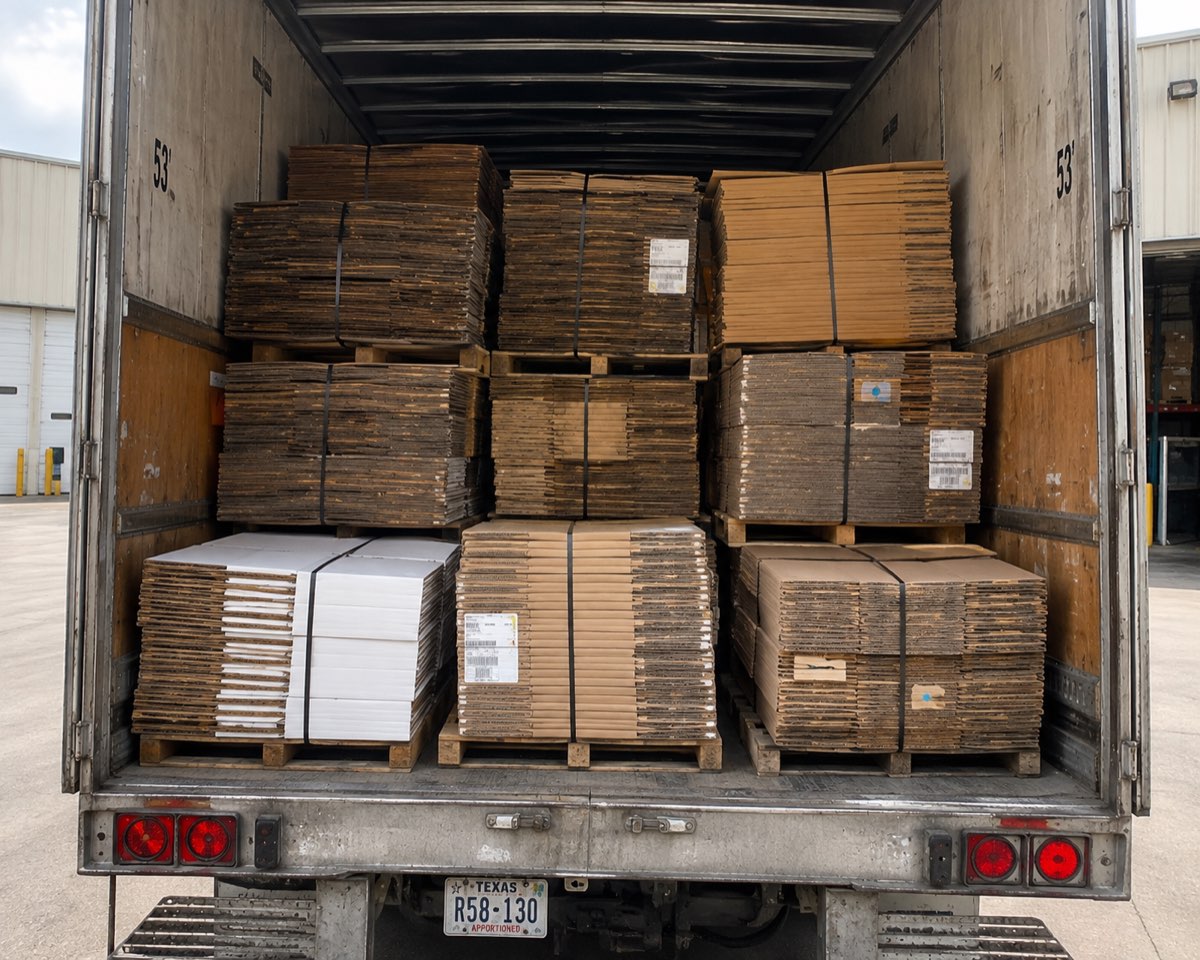
Rear view of a loaded box truck holding banded bundles of knocked-down boxes and assembled bins
Load-locked and banded. Corrugated that slides in transit arrives crushed.
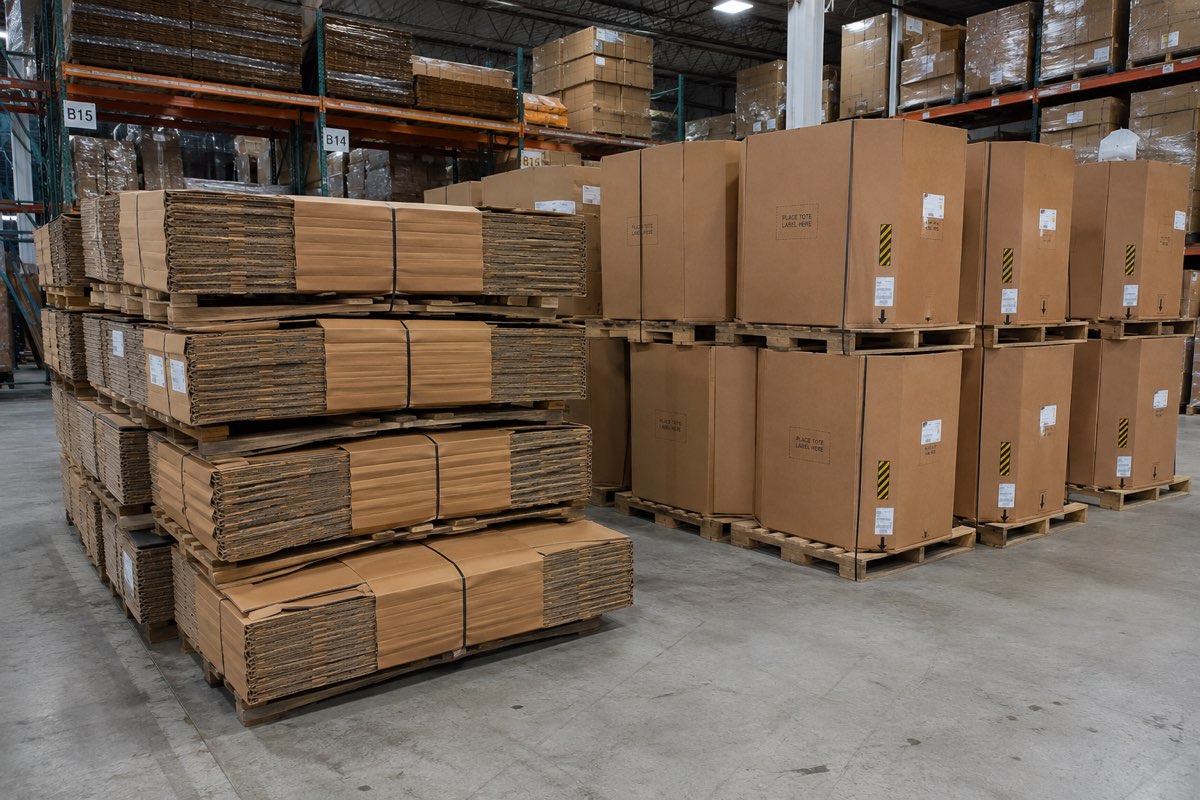
Flat banded bundles of knocked-down boxes on the left and assembled bulk bins on pallets on the right
Flat on the left, assembled on the right. The difference is most of your freight bill.
Run it

Answer six, get a spec

Nothing here is stored or sent anywhere until you press the button at the bottom.

Grade Decoder

0 of 6 answered

01How heavy is one full box?

Weigh a real one if you can. Estimates are where over-specification starts.

02How high will you stack them?

The bottom box carries everything above it, not including itself.

03How long does a loaded box sit?

Corrugated creeps. Six months of load is not the same as six hours.

04Where does it live?

Corrugated loses roughly half its strength at 90% relative humidity.

05Who sees the box?

Cosmetics decide grade. They never decide strength.

06How does the material behave?

If it would pour out of a tipped box, you want eight sides.

Answer all six and the decoder returns a wall count, a grade and a footprint you can paste straight into a purchase order.

The logic, in the open

What the decoder is actually doing

Step one — the load your bottom box carries

Weight of one full box × (stack height − 1). If you never stack, we still apply a 35% self-load allowance, because a box sitting alone still has to hold its own contents against its own walls.

Step two — the derates

Storage duration multiplies by 1.0 to 1.6 (corrugated creeps under sustained load). Environment multiplies by 1.0 to 1.5 (corrugated retains roughly half its dry strength at 90% relative humidity). Both are applied, not just the worst one.

Step three — the mapping

Under 1,100 lb is 2-wall. Up to 1,900 lb is tri-wall. Up to 2,900 lb is 4-wall. Above that is 5-wall. Sharp material bumps one grade, because sharp edges cut liner from the inside on the first fill.

Step four — grade and shape

Grade is a cosmetic and compliance question, not a strength one: regulated needs new, customer-facing needs A, internal needs B, one-way needs C. Shape is decided by whether your material flows — if it would pour out of a tipped box, eight sides distribute the outward pressure that blows corners out of square ones.

Is the result binding?

No — it is a well-reasoned starting point, not a certification. Send it with your quote request and a person will sanity-check it against what we have on the floor.

Why does it sometimes recommend a cheaper box than I asked for?

Because over-specification is the most common expensive habit in bulk packaging. Each extra wall adds 25–35% to the price. If your load does not need it, we will say so.

Does it store my answers?

No. Nothing leaves your browser until you press the button that opens a quote form, and then only what is in that form.

What if my situation is unusual?

Then the decoder will be roughly right and a person will be exactly right. Send the result plus a description and we will work through it.

Ready to move some boxes?

Send the form once. We answer in writing with grades, quantities, sizes and freight — no phone tag, because we don't even have a phone number.

Quick reference

Every number on this site, on one screen

The numbers we get asked for most

Standard size
48" × 40" × 36"
Standard volume
40 cu ft nominal
Usable volume
80–85% of nominal
Capacity range
900 – 4,500 lb
Per 53′ trailer, KD
≈ 480 boxes
Per 53′ assembled
26 pallet positions
Overhang penalty
≈ 20% per inch
Humidity at 90% RH
≈ 50% strength
Trips per box
3–6 when handled well
New box CO₂e
≈ 13 lb
Reuse cycle CO₂e
≈ 1.2 lb
OCC per 53′ trailer
≈ 20 tons

Stocked sizes, capacities and truckload counts

Inside dimensionsVolumeCapacityPer 53′ KDStock
48″ × 40″ × 3640 cu ft1,200 – 2,800 lb480Deep stock
48″ × 40″ × 3033.3 cu ft1,000 – 2,000 lb540Deep stock
48″ × 40″ × 2426.7 cu ft900 – 1,800 lb600Regular stock
48″ × 40″ × 4246.7 cu ft1,800 – 3,000 lb420Regular stock
48″ × 40″ × 4853.3 cu ft2,500 – 4,000 lb360Regular stock
40″ × 48″ × 4550 cu ft2,400 – 3,400 lb390Seasonal
41″ × 28″ × 2516.6 cu ft700 – 1,400 lb900Regular stock
30″ × 30″ × 3015.6 cu ft500 – 900 lb1100Regular stock
45″ × 30″ × 4535.2 cu ft1,500 – 2,200 lb560Seasonal
47″ × 38″ × 4445.5 cu ft2,000 – 3,000 lb400Seasonal
48″ × 48″ × 4053.3 cu ft2,800 – 4,500 lb320Made to order
48″ × 40″ × 4044.4 cu ft2,500 – 4,000 lb400Regular stock

Inside dimensions. Outside runs ½″ to 1½″ larger per dimension depending on wall count — use OD for racking and trailer clearances. Full size chart →

Wall count and load ratings

WallsStatic loadStackTypical ECT
2-wall1,000–1,200 lb2 high48–61 lb/in
3-wall (tri-wall)1,800–2,000 lb2–3 high71–82 lb/in
4-wall2,500–3,000 lb3 high90–110 lb/in
5-wall4,000 lb+3–4 high120+ lb/in

Ratings assume dry, aligned, fully supported, short duration. Derating explained →

Grades, at a glance

GradeConditionTrips left
1AStraight from the corrugator, unused, printed or plain.4–6 trips typical
AOne fill, clean, no repairs, no cuts. The sweet spot.3–5 trips typical
BTwo or three uses. Up to two clean repairs. Structurally honest.2–3 trips typical
CWorking boxes. Cosmetically rough, structurally usable, cheap.1–2 trips typical
SCRAPEnd of life as a container. Beginning of life as fiber.Reborn as new liner within weeks

Every pass/fail threshold →

Derating factors — apply all that fit, multiplied

ConditionFactorWhy
Storage under a month×1.0No creep adjustment needed
One to six months loaded×1.4Corrugated creeps under sustained load
Over six months loaded×1.6Long-term storage
Dry warehouse×1.15Mild humidity exposure
Open dock, no A/C×1.3Most of Houston, most of the year
Outdoors or cooler×1.5Needs a lid as well

Required load = full box weight × (stack − 1) × creep × humidity. Run it automatically →

Service area and turnaround

AreaTurnaroundRegion
HoustonSame day, most ZIPsHarris County
Pasadena & Deer ParkSame dayShip Channel East
Conroe & The WoodlandsSame dayMontgomery County
Beaumont & Port ArthurNext day, scheduled routesGolden Triangle
Dallas–Fort WorthScheduled backhaul lanesNorth Texas
San Antonio & AustinScheduled lanes, 2–4 daysI-35 Corridor
Yard
1050 E Richey Rd, Houston, TX 77073
Monday – Friday
7:00 AM – 5:00 PM CT
Saturday
8:00 AM – 12:00 PM CT
Sunday
Closed
Telephone
None — every quote is issued in writing
Quote turnaround
One business day