The Gaylord Box Guide
Everything worth knowing about bulk corrugated in one place: what these boxes are, how they are built, how to specify one, what it costs to move, how long it can live and what happens when it cannot live any longer.
Get a written quote in one business day
Tell us what you have or what you need. A real person in Houston reads every one of these — usually within a couple of hours during dock time.
Twelve chapters
1. What a gaylord box actually is
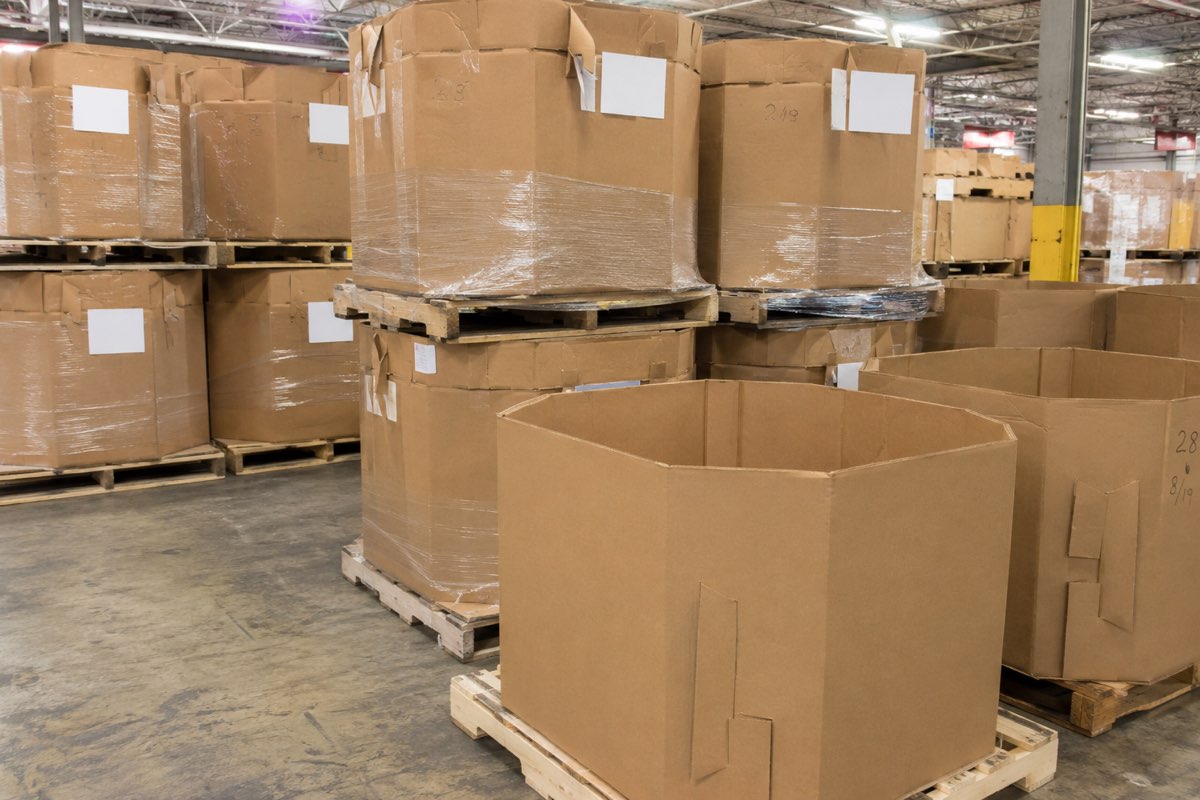
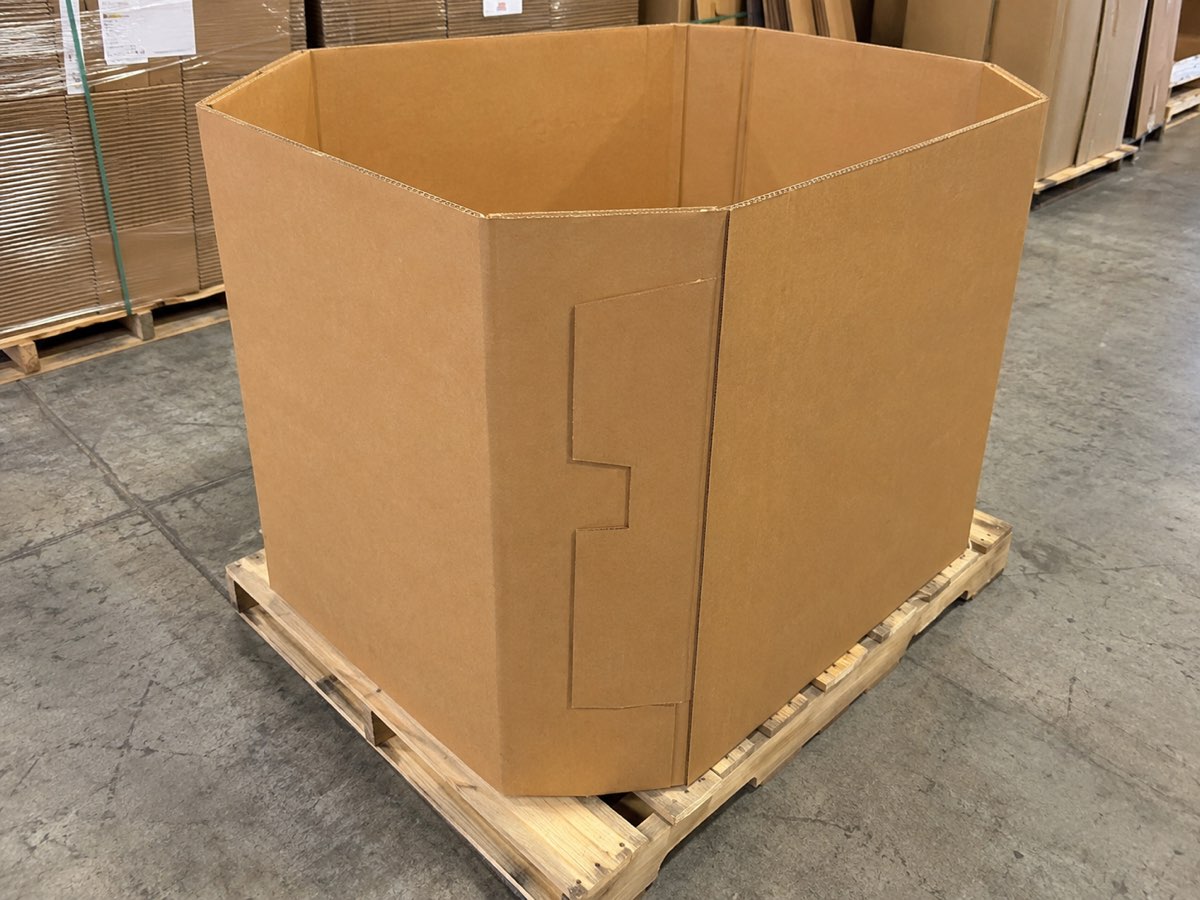
A gaylord box is a corrugated container sized to a pallet, built to carry bulk material — usually between 1,000 and 4,500 lb of it — and designed to be filled from above, moved by forklift and stacked. The standard footprint is 48 inches by 40 inches, matching the GMA pallet, with wall heights from 24 to 48 inches.
That is the whole object. Everything else in this guide is a variation on three questions: how strong does it need to be, what condition is it in, and how does it get from where it is to where you need it.
You will hear the same object called a bulk box, bulk bin, pallet box, tote box, skid box, octabin or bulk container. The terminology varies by region and industry and almost never carries useful information. What carries information is inside dimensions, wall count and grade.
2. Where the name came from
Gaylord Container Corporation, of St. Louis, was an early large-scale producer of pallet-sized bulk containers in the mid twentieth century. Their name became the generic term the same way Dumpster and Thermos did — through market dominance at the moment a category was forming. The company is long since absorbed into larger paper concerns; the word outlived it comfortably.
This matters practically in exactly one way: nobody owns the term, so nobody standardises it. When a supplier says 'a gaylord', ask for inside dimensions and wall count. When a supplier resists giving you inside dimensions and wall count, that tells you something.
3. Anatomy: liner, flute and why geometry is everything
Corrugated board is a sandwich: flat liner sheets on the outside, a fluted medium waved between them. The flutes are arches, and arches are how you get enormous compression strength out of paper. Everything a corrugated box can do, it does because of that geometry.
The consequence is worth internalising because it drives every buying decision in this trade: damage that changes the geometry is catastrophic, and damage that does not is cosmetic. A crushed flute is a permanent loss of strength. A logo scrubbed off with a wire brush is nothing at all.
- Liner — the flat facing sheets. Basis weight affects puncture resistance and printability.
- Medium — the fluted layer. Where the strength lives.
- Wall — one medium plus its liners. Bulk boxes count total fluted layers: 2-wall, 3-wall, 4-wall, 5-wall.
- Score line — where the board is intended to fold. Folding anywhere else crushes flutes.
- Flap — the folding panel at top or bottom. Style varies (RSC, full overlap, half-slotted).
4. Sizes, and why each one exists
There are roughly a dozen sizes in common circulation, and each one exists because a specific combination of material density and handling made the others wrong.
| Size (ID) | Volume | Exists because |
|---|---|---|
| 48" × 40" × 36" | 40 cu ft | It fits a GMA pallet exactly. The default. |
| 48" × 40" × 30" | 33 cu ft | Dense material hits weight before it fills volume. |
| 48" × 40" × 24" | 27 cu ft | Picking height for hand operations. |
| 48" × 40" × 42" | 47 cu ft | Light bulky material — you buy volume, not strength. |
| 48" × 40" × 48" | 53 cu ft | The practical ceiling for a single stack. |
| 41" × 28" × 25" | 17 cu ft | Two per pallet, for weekly instead of monthly fill rates. |
| 30" × 30" × 30" | 16 cu ft | One person can drag it. Lab and e-scrap sorting. |
| Octagon 48 × 40 × 40 | 44 cu ft | Free-flowing solids need eight sides, not four. |
The mistake most buyers make here is inheriting a size. Somebody chose 48 × 40 × 36 in 2009 and nobody has asked since whether the material actually fills it. If your boxes routinely ship at 60% full by volume and 100% by weight, you are paying to ship air — a shorter box is cheaper to buy and cheaper to freight.
5. Wall count, ECT and load ratings
| Walls | Static load | Stack | Typical use |
|---|---|---|---|
| 2-wall | 1,000–1,200 lb | 2 high | Textiles, foam, film |
| 3-wall (tri-wall) | 1,800–2,000 lb | 2–3 high | The workhorse — most plastics and recycling |
| 4-wall | 2,500–3,000 lb | 3 high | E-scrap, metal, long storage |
| 5-wall | 4,000 lb+ | 3–4 high | Aggregate, foundry, chemical powders |
Those numbers assume dry, aligned, fully supported and short duration. Apply the derates: ×1.4 for storage beyond three months (corrugated creeps under sustained load), ×1.3 for humid conditions (it retains roughly half its strength at 90% RH). Apply both, not the worse of the two.
Edge crush test (ECT) — pounds per linear inch a board edge takes before buckling — predicts stacking better than wall count, because it measures the finished board including glue quality and converting crush. A well-made tri-wall beats a badly made 4-wall reliably.
6. Grades: new through scrap
| Grade | Condition | Price vs new | Trips left |
|---|---|---|---|
| 1A | New, never filled | 100% | 4–6 |
| A | One use, no cuts, square, dry | 35–55% | 3–5 |
| B | Up to two clean patched repairs | 20–35% | 2–3 |
| C | Multiple repairs, still self-standing | 10–20% | 1–2 |
| Scrap | Soft corners, bulged, wet, odour | Fiber value by the ton | 0 |
Grade is decided by a six-point inspection: corners, bottom seam, wall integrity, flaps, moisture and odour. It takes ninety seconds per box and it produces the same answer regardless of who is holding the clipboard, which is the entire point of having thresholds rather than opinions.
7. How to specify a box in five steps
- Weigh one full box of your actual material. Not the estimate — the real thing, on a scale.
- Multiply by (stack height − 1). The bottom box carries everything above it.
- Multiply by 1.4 if it sits loaded for more than three months.
- Multiply by 1.3 if it stores in a humid dock, a cooler, or outdoors.
- Match that number to a wall count, then pick grade by who sees the box: regulated → new, customer-facing → A, internal → B, one-way → C.
Size follows from volume: divide the weight of a full box by your material's bulk density to get required cubic feet, then add 20% because nobody fills a box flush to the rim. If the answer is under 30 cubic feet you want a short wall; over 45 and you want a tall one.
8. Lids, liners, pallets and the parts that decide everything
- Telescoping lid — fits over the outside of the walls. Sheds water, protects the top edge (the first thing to crush), and lets you stack without a cap.
- Pallet cap — a flat top sheet. Cheaper, fine indoors, useless in rain.
- Liner — 2 to 6 mil poly, anti-static for resin, FDA-compliant for food, spouted for bottom discharge. For fine material, the liner is the actual container.
- Pallet — must match the box footprint exactly. One inch of overhang costs roughly 20% of stacking strength, because the corners lose their support.
- Corner boards — L-profile under banding. Spreads strap tension off the corner, which is the structural element you most need to protect.
9. Freight economics
In bulk corrugated, freight regularly costs more than the boxes. A 53-foot trailer holds about 480 knocked-down 48 × 40 × 36 boxes, or 26 pallets of assembled ones — a difference of roughly eighteen times in freight cost per box.
This is why the landed cost, not the unit price, is the only number worth comparing. Box price plus linehaul (roughly $2.20–$3.40 per mile on Texas dry-van lanes) plus fuel surcharge (18–28% of linehaul) plus accessorials plus your own unloading labour, divided by quantity.
The corollary: buying boxes 400 miles away to save 20% on unit price frequently costs more delivered, and always costs more in lead time and flexibility. And the biggest single saving available is pairing — a trailer that is paying in both directions is roughly 40% cheaper per direction.
10. Reuse, loops and trips per box
Trips per box is the only sustainability metric in this industry that actually means anything. Manufacturing a new tri-wall box produces roughly 13 lb of CO₂e; putting an existing box back in service costs about 1.2 lb. Every additional trip divides the manufacturing emission by a larger number.
Getting from one trip to four is not a technology problem, it is a habits problem. Four habits do most of the work:
- Boxes never touch bare concrete — it wicks moisture straight into the bottom board.
- Knock down within 48 hours of emptying. Standing empties get crushed and disappear.
- Cut across the top flap, never down a corner. This single habit is worth about a trip and a half.
- Sort reusable from scrap at the moment of emptying, by the person who just looked inside.
11. End of life: baling, OCC and the mill
When a box genuinely cannot work any longer, it is stripped of staples, banding and plastic, baled as OCC (old corrugated containers) grade #11 or #12, weighed and sold to a regional containerboard mill. There it is repulped, screened, cleaned and re-formed into new liner — typically back on a truck as a new box within three to five weeks.
Corrugated fiber survives roughly five to seven pulping cycles before the fibers grow too short to bond well, which is why recycled content never reaches 100% and why every cycle you extract before repulping is genuinely valuable.
One ton of recovered OCC saves roughly 17 trees, 7,000 gallons of water, 4,100 kWh and 3.3 cubic yards of landfill volume. A 53-foot trailer holds about 20 tons of it.
12. The eight most expensive mistakes
- Over-specifying wall count. Each wall adds 25–35% to price. Buy one grade above your calculated need, not three.
- Buying Grade A for boxes that never leave the building. You are paying for cosmetics nobody will see.
- Comparing unit price instead of landed cost. Freight is usually the bigger number.
- Shipping assembled when knocked down would do. You are paying to freight air.
- Pallet mismatch and overhang. One inch costs 20% of stacking strength, at the corners.
- Storing boxes on bare concrete. Moisture wicks up, and moisture is permanent.
- Cutting boxes open down the corner instead of across the top flap. Kills a box a trip early, every time.
- Compacting corrugated that had resale value. About a third of what gets called scrap is still a working box.
Every one of those is free to fix. None of them requires buying anything from us, which is why we are comfortable writing them down.
Keep going: the master size chart has every stocked footprint with capacities and truckload counts, grades explained publishes the full inspection thresholds, and the Grade Decoder runs the specification logic from chapter seven for you.
The guide — common questions
What is a gaylord box?
A bulk corrugated container sized to sit on a pallet, holding roughly 1,000 to 2,500 lb depending on wall count. The name comes from the Gaylord Container Corporation and stuck as a generic term.
Do I need to read the whole guide?
No. It is written in order so it reads front to back, but each chapter stands alone. If you only need a footprint and a wall count, the size chart and the Grade Decoder will get you there faster.
Is the guide free?
Entirely, with nothing gated behind a form. It gives away most of what a salesperson would normally hold back, which we are comfortable with.
Does it cover used boxes specifically?
Yes, in detail — the grading thresholds, what a prior fill actually costs you in strength, and the three situations where buying new is genuinely the right call instead.
Where should I go after the guide?
Grades explained publishes the full inspection thresholds, the glossary defines every term, and the Grade Decoder runs the specification logic for your own load.