The vocabulary, without the mystique
Every trade builds a private language, and every private language eventually gets used as leverage. Here is ours, in plain terms — enough to hold your own with a broker and to notice when one is being vague at you.
Get a written quote in one business day
Tell us what you have or what you need. A real person in Houston reads every one of these — usually within a couple of hours during dock time.
B
- Bale
- A compressed, banded block of recovered corrugated, typically 1,100–1,400 lb. Mills buy fiber by the bale-load; density affects the price they pay.
- Basis weight
- The weight of paper per unit area, historically pounds per 1,000 square feet. Higher basis weight liner generally means a stronger board.
- Bulk bin
- Generic term for a pallet-sized container. Covers corrugated gaylord boxes and rigid plastic bins alike.
- Burst strength
- The pressure a board withstands before rupturing, measured by a Mullen test. Relevant to puncture resistance, less predictive of stacking than ECT.
C
- Corner board
- An L-shaped fiber or plastic profile placed on a box corner under banding to spread strap pressure and protect the corner.
- Corrugator
- The machine — and by extension the plant — that glues fluted medium between liners to make corrugated board.
- Creep
- The gradual deformation of corrugated under sustained load. A box holding weight for six months carries roughly 60% of its short-term rating.
D
- Double-sorted OCC (#12)
- A premium grade of recovered corrugated: clean, sorted, under 2% prohibitives, no other paper types mixed in.
E
- ECT
- Edge Crush Test. Pounds per linear inch a board edge withstands before buckling. The best single predictor of stacking performance.
F
- Flute
- The wavy medium between liners. Its arch geometry is what gives corrugated its strength-to-weight ratio.
G
- Gaylord box
- A pallet-sized bulk corrugated container, usually 48" × 40" footprint. Named after the Gaylord Container Company; now a generic term.
- GMA pallet
- The Grocery Manufacturers Association standard pallet, 48" × 40". The reason the standard gaylord box footprint is what it is.
- Grade (box)
- A condition classification for used boxes. 1A new, A one clean use, B up to two repairs, C multiple repairs, then scrap.
H
- Hoop stress
- Circumferential stress in a container wall under internal pressure. Octagon bins distribute it; square boxes concentrate it in corners.
I
- IBC tote
- Intermediate Bulk Container. A 275 or 330 gallon caged plastic vessel for liquids. Not a competitor to corrugated for dry solids.
K
- Knocked down (KD)
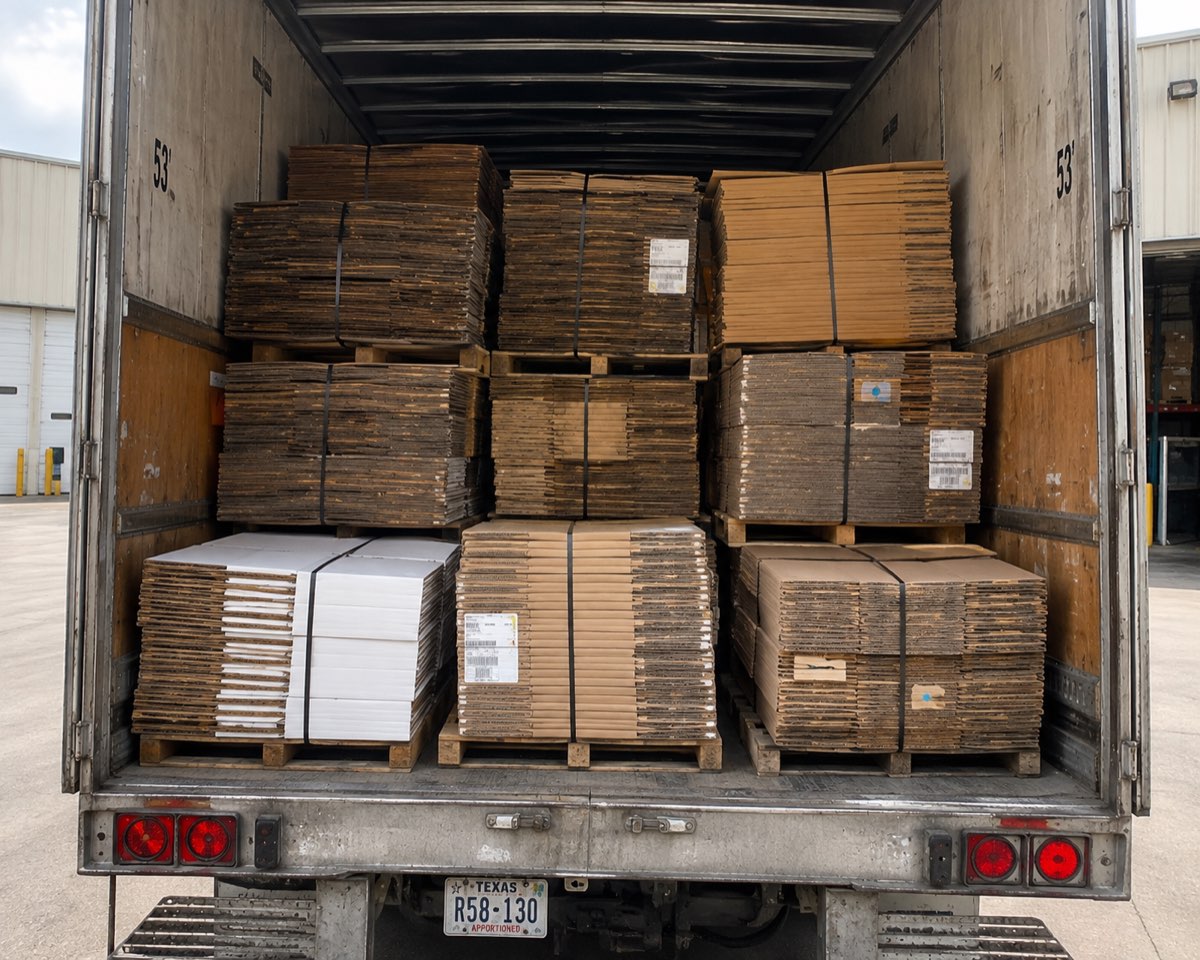
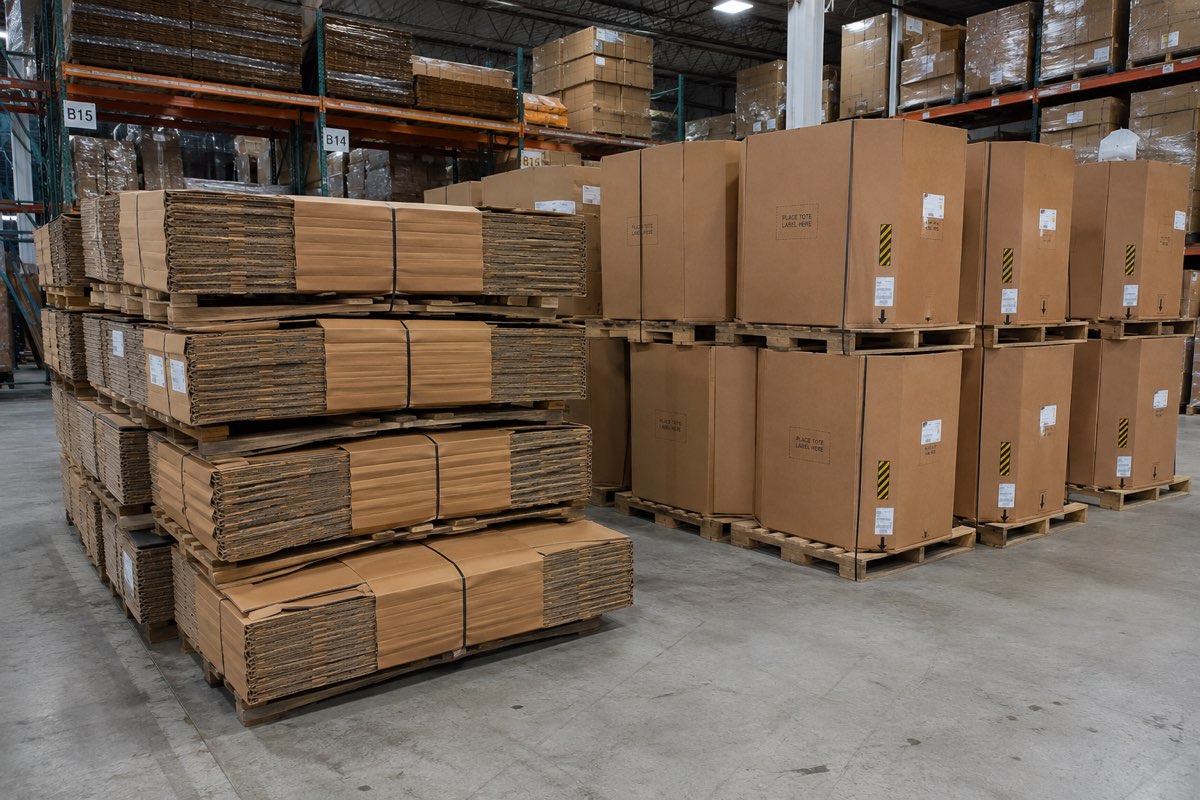
- Shipped flat rather than assembled. Roughly four times more boxes per trailer, which is why almost all used inventory ships this way.
L
- Liner
- The flat facing sheets on either side of the fluted medium.
M
- McKee formula
- An engineering estimate of box compression strength derived from ECT, board thickness and box perimeter.
- Medium
- The fluted inner layer of corrugated board.
O
- OCC
- Old Corrugated Containers. The recovered-fiber commodity grade that used boxes become at end of life.
- Octabin / octagon bin
- An eight-sided bulk container. Better under vibration and with free-flowing solids than a square box.
- One-way box
- A container intended for a single trip, priced accordingly. Often Grade C.
- Overhang
- Box extending past the pallet edge. One inch can cost 20% of stacking strength because the corners lose support.
P
- Pallet cap
- A corrugated cover placed over a loaded pallet or box to protect the top and enable stacking.
- Prohibitives
- Non-fiber contaminants in a bale — plastic, metal, wax, food residue. Mills specify maximum percentages by grade.
R
- Reconditioning
- Inspecting, cleaning and repairing a used box so it can re-enter service at a defined grade.
- Regrind
- Plastic scrap ground into flake for reprocessing. One of the highest-volume materials shipped in gaylord boxes on the Gulf Coast.
- Repulping
- Breaking a bale down in water at the mill to recover fiber. Corrugated fiber survives roughly 5–7 cycles.
S
- Scrap
- A box that is no longer viable as a container. Still valuable — as fiber, by the ton.
- Self-standing
- A box that holds its own shape empty. The first and fastest test of whether a box is still usable.
- Sleeve
- A four-sided corrugated body without top or bottom, used with a separate cap and base.
T
- Tare weight
- The weight of the empty container. Matters when your load is sold by net weight.
- Telescoping lid
- A lid that fits down over the outside of the box walls rather than sitting inside them.
- Tide line
- A wavy discoloured band showing a box stood in water. Permanent strength loss even after drying.
- Tri-wall
- Three-ply corrugated board. The most common construction for bulk boxes and the default for most industrial applications.
W
- Wall count
- The number of fluted layers. 2-wall through 5-wall in common use.
Terminology — common questions
Why does the same box have so many different names?
Gaylord, bulk bin, tote, pallet box, skid box and octabin all describe the same family of container. The vocabulary varies by industry and by region more than by product.
Where does the word gaylord come from?
The Gaylord Container Corporation, which made them. Like thermos or dumpster, a brand name drifted into generic use and never went back.
What is the difference between ECT and Mullen?
Two different board tests. ECT measures edge crush, which predicts stacking strength; Mullen measures burst resistance, which predicts puncture. Bulk boxes stack, so ECT is the number that matters.
What does wall count mean?
How many layers of fluted board make up the side. More walls means more stacking strength and more weight capacity, and it is the single biggest lever on what a full box can safely hold.
A term I need is missing. Can you add it?
Send it over. The glossary grew out of questions people asked us, so a missing entry is usually one somebody else needed too.