Recover
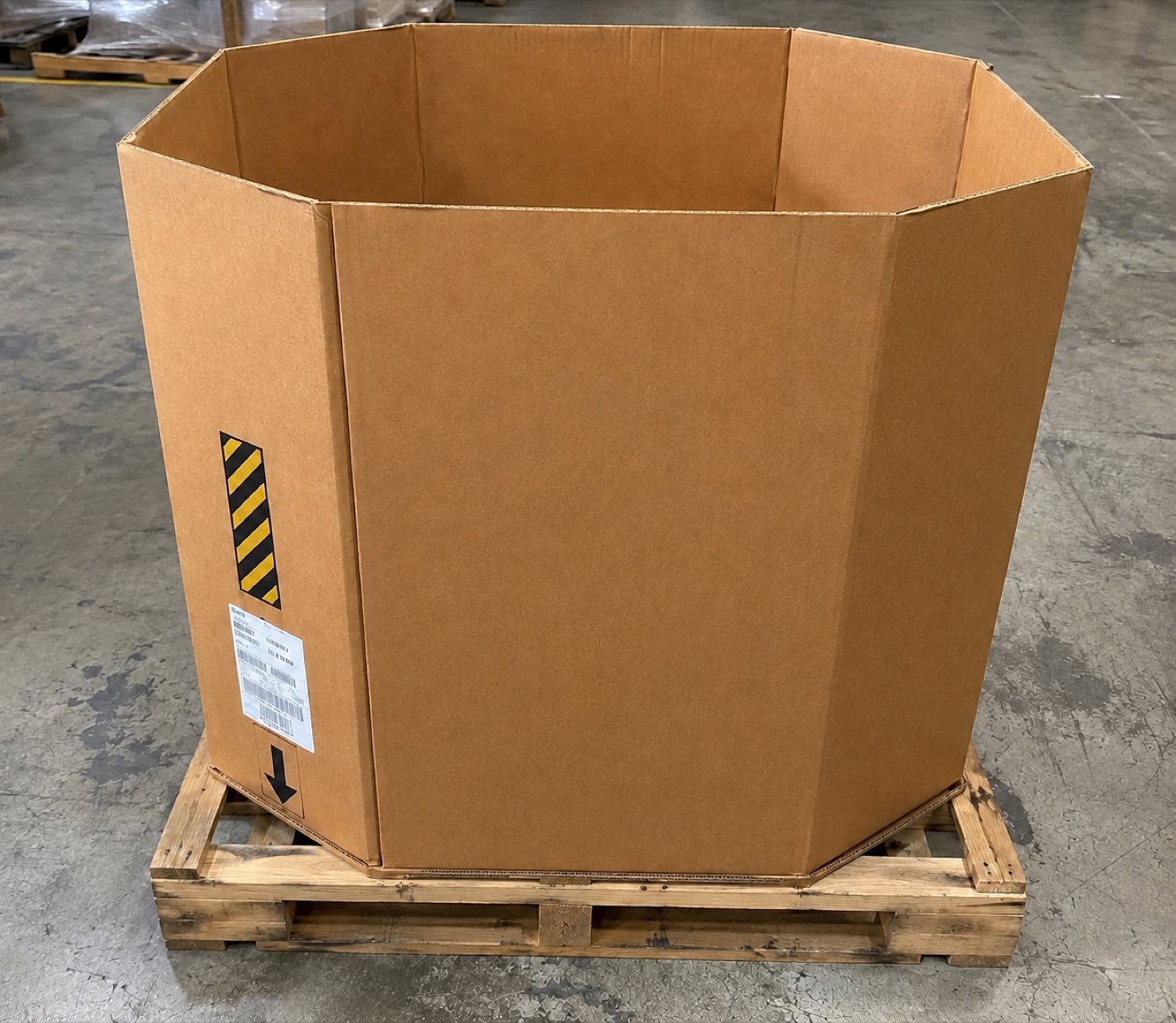
We collect used bulk boxes from plants, distribution centres and warehouses across the Houston metro — including the ones everybody else would have compacted.
We buy, grade, recondition, sell, haul and recycle bulk corrugated across Texas — so a box built for five trips does not die after one. Same-day stock on standard 48×40s. Written quotes in one business day. No phone tag, because we do not have a phone.
One form covers buying, selling, recycling, freight and fabrication. A Houston dispatcher reads every submission and answers in writing, usually the same day.
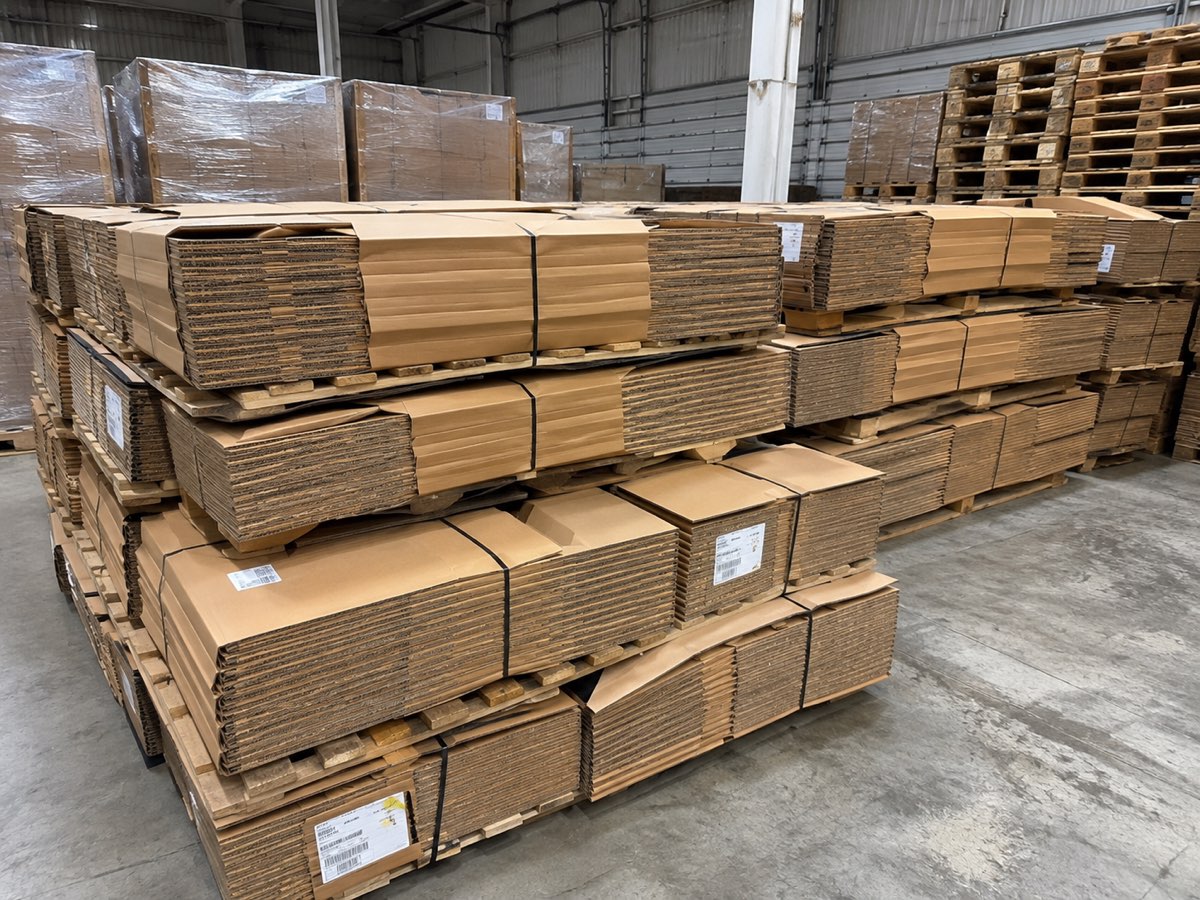
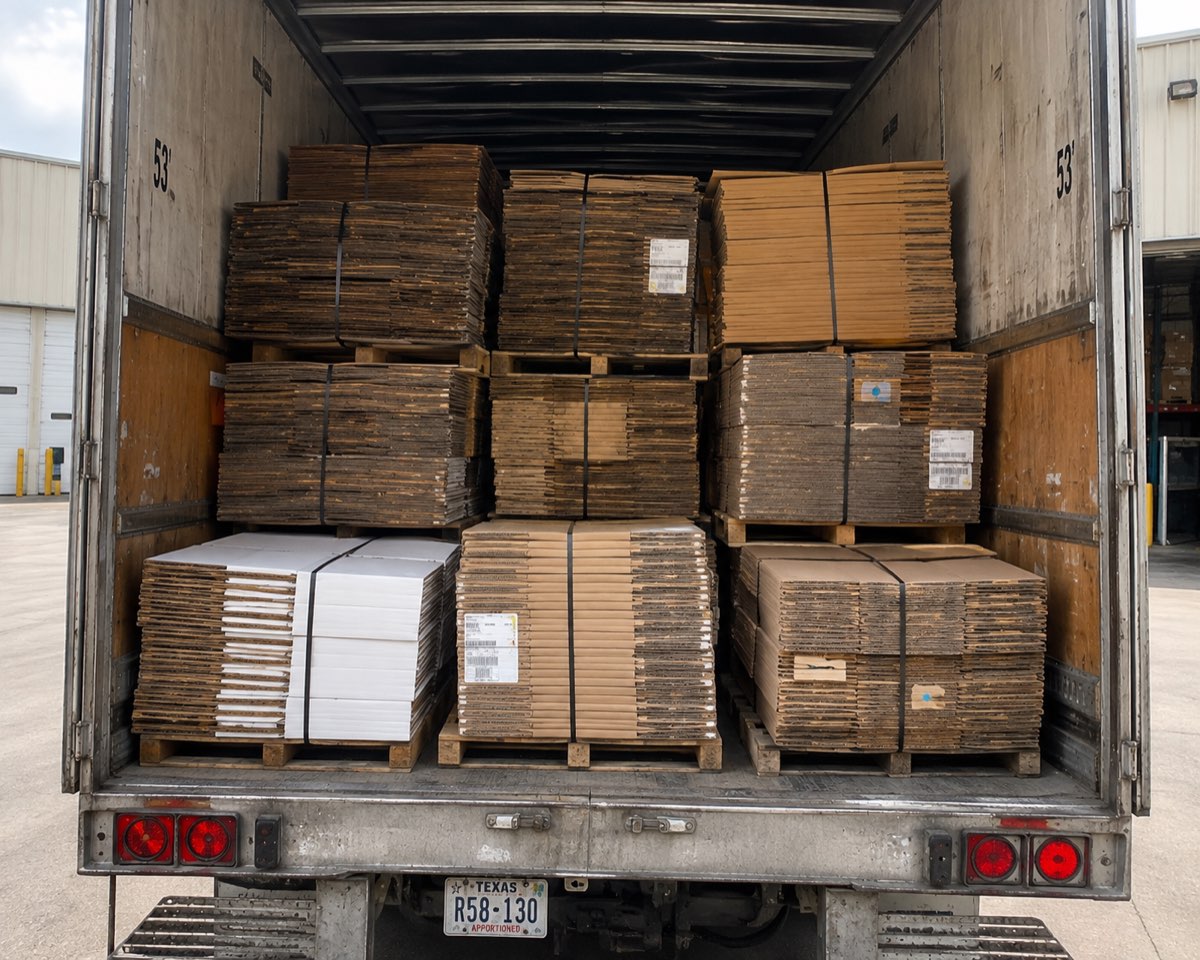
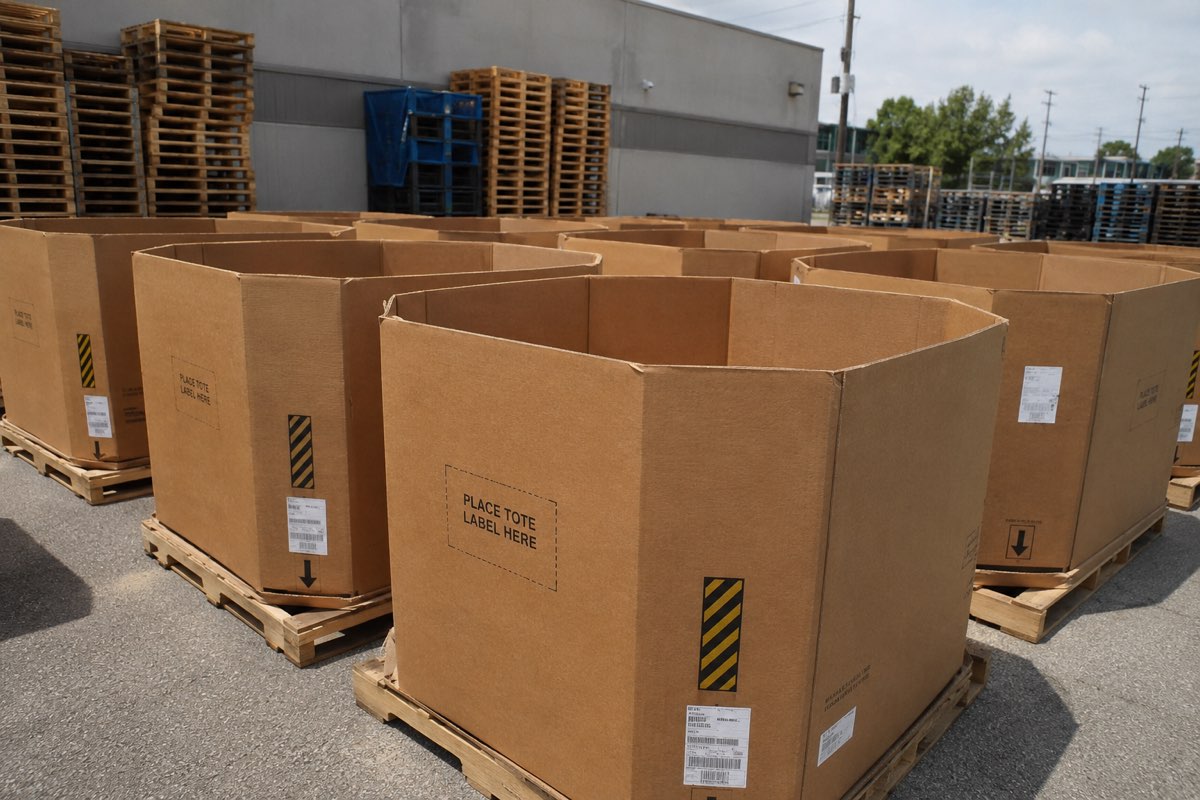
Most suppliers do one leg of this. We do the whole loop, which is why the same trailer can drop graded boxes and take your empties home.
This is the actual route a box takes through our yard on E Richey Rd. Nothing skips a station, including the ones that arrive looking finished.
We collect used bulk boxes from plants, distribution centres and warehouses across the Houston metro — including the ones everybody else would have compacted.
Six-point inspection on every box: corners, bottom seam, walls, flaps, moisture, odour. Cosmetics never change a grade. Geometry always does.
Patches, re-taped seams, replacement flaps, cut-downs to a shorter wall. Roughly a fifth of what comes back needs a hand to get another two trips.
Graded stock goes back out to buyers who need a working box today, not a manufacturing slot in four weeks.
Board that will never be a box again becomes dividers, layer pads, partitions, display bases and custom inserts on our fabrication table.
Whatever is left is stripped of metal and plastic, baled as OCC and sold to regional mills. It is new liner inside five weeks. Nothing structural goes to landfill.
Most buyers order the wrong box because nobody ever explained the relationship between material density, storage time, humidity and wall count. Our decoder walks that logic in public and hands you a wall count, a grade and a size you can paste straight into a purchase order — then drops it into a quote request if you want us to fill it.
Weigh one full box. Not the estimate.
The bottom box carries everything above it.
Corrugated creeps. Months change the spec.
A humid dock costs 30% of your rating.
Cosmetics decide grade, not strength.
Powders and pellets want eight sides.
Every size in our catalogue solves a specific physics problem. Here are six of them — the full chart has capacities, truckload counts and a page for each size.
| Size (ID) | Walls | Capacity | Volume | Per 53′ | Best for |
|---|---|---|---|---|---|
| 48″ × 40″ × 36″ | 2-wall to 4-wall | 1,200 – 2,800 lb | 40 cu ft | 480 | The default. Regrind, textiles, plastics, e-scrap, retail returns. |
| 48″ × 40″ × 30″ | 2-wall to 3-wall | 1,000 – 2,000 lb | 33.3 cu ft | 540 | Dense material — metal turnings, glass cullet, wet fiber, minerals. |
| 48″ × 40″ × 24″ | 2-wall to 3-wall | 900 – 1,800 lb | 26.7 cu ft | 600 | Line-side WIP, heavy castings, ergonomic hand-pick stations. |
| 48″ × 40″ × 42″ | 3-wall to 4-wall | 1,800 – 3,000 lb | 46.7 cu ft | 420 | Fluff, foam, film, EPS, light plastics, apparel. |
| 48″ × 40″ × 48″ | 4-wall to 5-wall | 2,500 – 4,000 lb | 53.3 cu ft | 360 | Baled film, bulk pellets in liners, long parts, seat cushions. |
| 40″ × 48″ × 45″ | 4-wall | 2,400 – 3,400 lb | 50 cu ft | 390 | Automotive interiors, converted foam, bulky returns. |
Anyone can call a box 'good'. We publish the pass/fail thresholds so you can check our work on your own dock.
Straight from the corrugator, unused, printed or plain.
One fill, clean, no repairs, no cuts. The sweet spot.
Two or three uses. Up to two clean repairs. Structurally honest.
Working boxes. Cosmetically rough, structurally usable, cheap.
End of life as a container. Beginning of life as fiber.
What passes, what fails, what a repair counts as, and how to grade a box in ninety seconds without training.
Manufacturing a new tri-wall box produces roughly 13 lb of CO₂e. Putting an existing box back into service costs about 1.2 lb, all-in, including inspection, repair and local freight. There is no offset in that number and no certificate. The box already exists — every extra trip divides its emissions by a bigger number.
Resin does not want the same container as apparel, and e-scrap does not want either. Pick your world and we will tell you exactly what to order.
Regrind, purge, pellets and film — the biggest single user of bulk corrugated on the Gulf Coast.
GRADE 1A / AProduce, nuts, grain, dry ingredients — where sanitation rules the spec.
GRADE A / BHeavy, sharp, valuable and audited to the pound.
GRADE B / CLight, bulky, and priced by the cubic foot rather than the pound.
GRADE 1A / APowders, minerals, catalysts and compounds that punish weak packaging.
GRADE A / BThe reverse-logistics flood — and the boxes that soak it up.
Freight math, grading procedure, wall-count physics and what actually happens to a box after its last trip.
A used Grade A gaylord box costs 35–55% of new and carries the same load in practice. Where used wins, and the three cases where it does not.
Operations · 6 minA repeatable six-point inspection your dock team can run in a minute and a half: corners, bottom, walls, flaps, moisture and odour.
Logistics · 8 minA 53-foot trailer holds about 480 knocked-down 48×40×36 gaylord boxes. How to calculate landed cost per box, and why buying local beats cheap.
Deliberate. Every quote we issue is in writing — sizes, grades, quantities, freight and terms on one page you can forward to purchasing. Phone quotes get misremembered. Send the form and you get a document instead of a conversation you have to reconstruct.
48" × 40" × 36". It matches the GMA pallet footprint exactly, which is the whole reason it exists in that dimension. Next most common are 48×40×30 for dense material and 48×40×42 for light bulky material.
A Grade A used box has one prior fill, no cuts and square corners — it performs within a few percent of new for every practical industrial load. Strength lives in the flute geometry, and geometry does not care about ink, labels or scuffing.
Same-day pickup from the yard on standard sizes in stock. Next-day delivery across most of the Houston metro. Two to four days on scheduled lanes to DFW, Austin, San Antonio and the Golden Triangle.
| Inside dimensions | Volume | Capacity | Per 53′ KD | Stock |
|---|---|---|---|---|
| 48″ × 40″ × 36″ | 40 cu ft | 1,200 – 2,800 lb | 480 | Deep stock |
| 48″ × 40″ × 30″ | 33.3 cu ft | 1,000 – 2,000 lb | 540 | Deep stock |
| 48″ × 40″ × 24″ | 26.7 cu ft | 900 – 1,800 lb | 600 | Regular stock |
| 48″ × 40″ × 42″ | 46.7 cu ft | 1,800 – 3,000 lb | 420 | Regular stock |
| 48″ × 40″ × 48″ | 53.3 cu ft | 2,500 – 4,000 lb | 360 | Regular stock |
| 40″ × 48″ × 45″ | 50 cu ft | 2,400 – 3,400 lb | 390 | Seasonal |
| 41″ × 28″ × 25″ | 16.6 cu ft | 700 – 1,400 lb | 900 | Regular stock |
| 30″ × 30″ × 30″ | 15.6 cu ft | 500 – 900 lb | 1100 | Regular stock |
| 45″ × 30″ × 45″ | 35.2 cu ft | 1,500 – 2,200 lb | 560 | Seasonal |
| 47″ × 38″ × 44″ | 45.5 cu ft | 2,000 – 3,000 lb | 400 | Seasonal |
| 48″ × 48″ × 40″ | 53.3 cu ft | 2,800 – 4,500 lb | 320 | Made to order |
| 48″ × 40″ × 40″ | 44.4 cu ft | 2,500 – 4,000 lb | 400 | Regular stock |
Inside dimensions. Outside runs ½″ to 1½″ larger per dimension depending on wall count — use OD for racking and trailer clearances. Full size chart →
| Walls | Static load | Stack | Typical ECT |
|---|---|---|---|
| 2-wall | 1,000–1,200 lb | 2 high | 48–61 lb/in |
| 3-wall (tri-wall) | 1,800–2,000 lb | 2–3 high | 71–82 lb/in |
| 4-wall | 2,500–3,000 lb | 3 high | 90–110 lb/in |
| 5-wall | 4,000 lb+ | 3–4 high | 120+ lb/in |
Ratings assume dry, aligned, fully supported, short duration. Derating explained →
| Grade | Condition | Trips left |
|---|---|---|
| 1A | Straight from the corrugator, unused, printed or plain. | 4–6 trips typical |
| A | One fill, clean, no repairs, no cuts. The sweet spot. | 3–5 trips typical |
| B | Two or three uses. Up to two clean repairs. Structurally honest. | 2–3 trips typical |
| C | Working boxes. Cosmetically rough, structurally usable, cheap. | 1–2 trips typical |
| SCRAP | End of life as a container. Beginning of life as fiber. | Reborn as new liner within weeks |
| Condition | Factor | Why |
|---|---|---|
| Storage under a month | ×1.0 | No creep adjustment needed |
| One to six months loaded | ×1.4 | Corrugated creeps under sustained load |
| Over six months loaded | ×1.6 | Long-term storage |
| Dry warehouse | ×1.15 | Mild humidity exposure |
| Open dock, no A/C | ×1.3 | Most of Houston, most of the year |
| Outdoors or cooler | ×1.5 | Needs a lid as well |
Required load = full box weight × (stack − 1) × creep × humidity. Run it automatically →
| Area | Turnaround | Region |
|---|---|---|
| Houston | Same day, most ZIPs | Harris County |
| Pasadena & Deer Park | Same day | Ship Channel East |
| Conroe & The Woodlands | Same day | Montgomery County |
| Beaumont & Port Arthur | Next day, scheduled routes | Golden Triangle |
| Dallas–Fort Worth | Scheduled backhaul lanes | North Texas |
| San Antonio & Austin | Scheduled lanes, 2–4 days | I-35 Corridor |