Used vs. new gaylord boxes: the honest comparison
A used Grade A gaylord box costs 35–55% of new and carries the same load in practice. Where used wins, and the three cases where it does not.
Have a question this raised?
Tell us what you have or what you need. A real person in Houston reads every one of these — usually within a couple of hours during dock time.
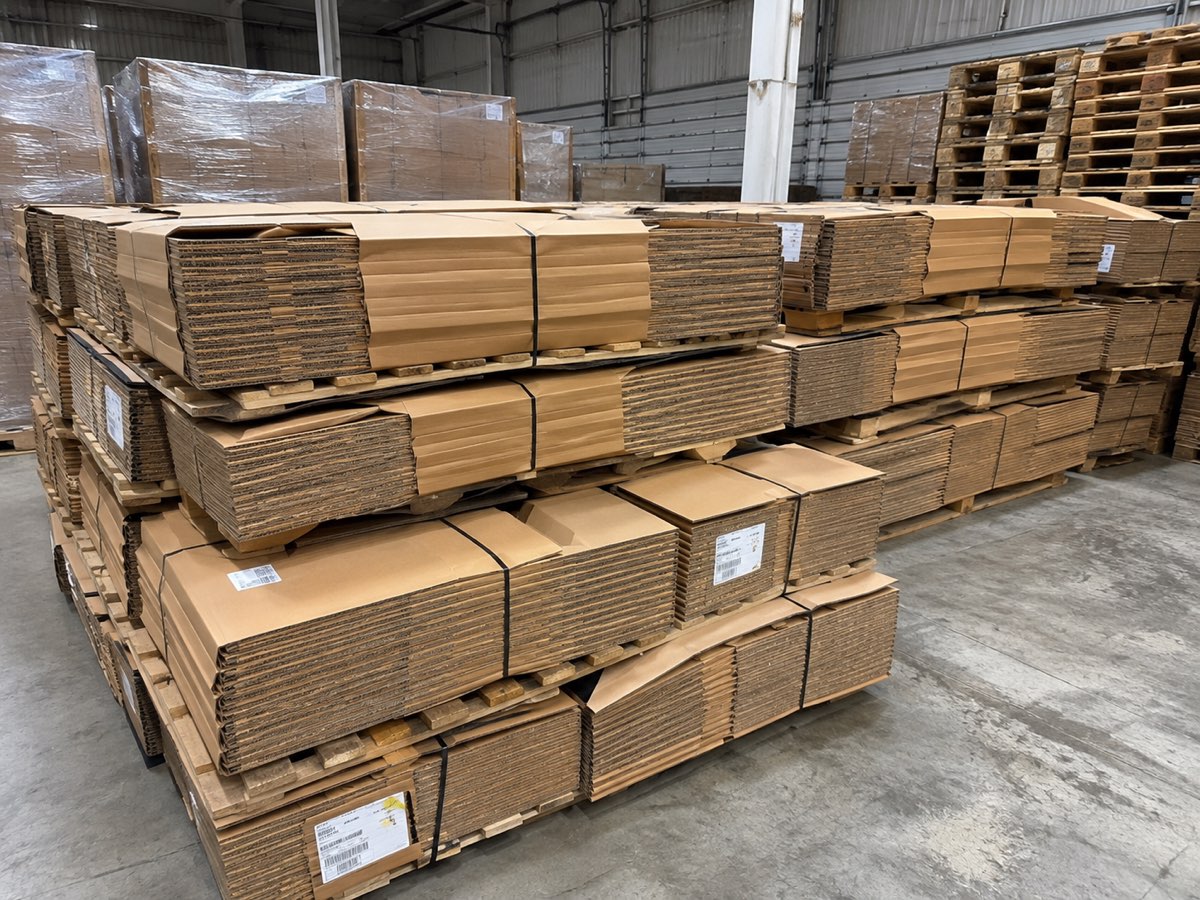
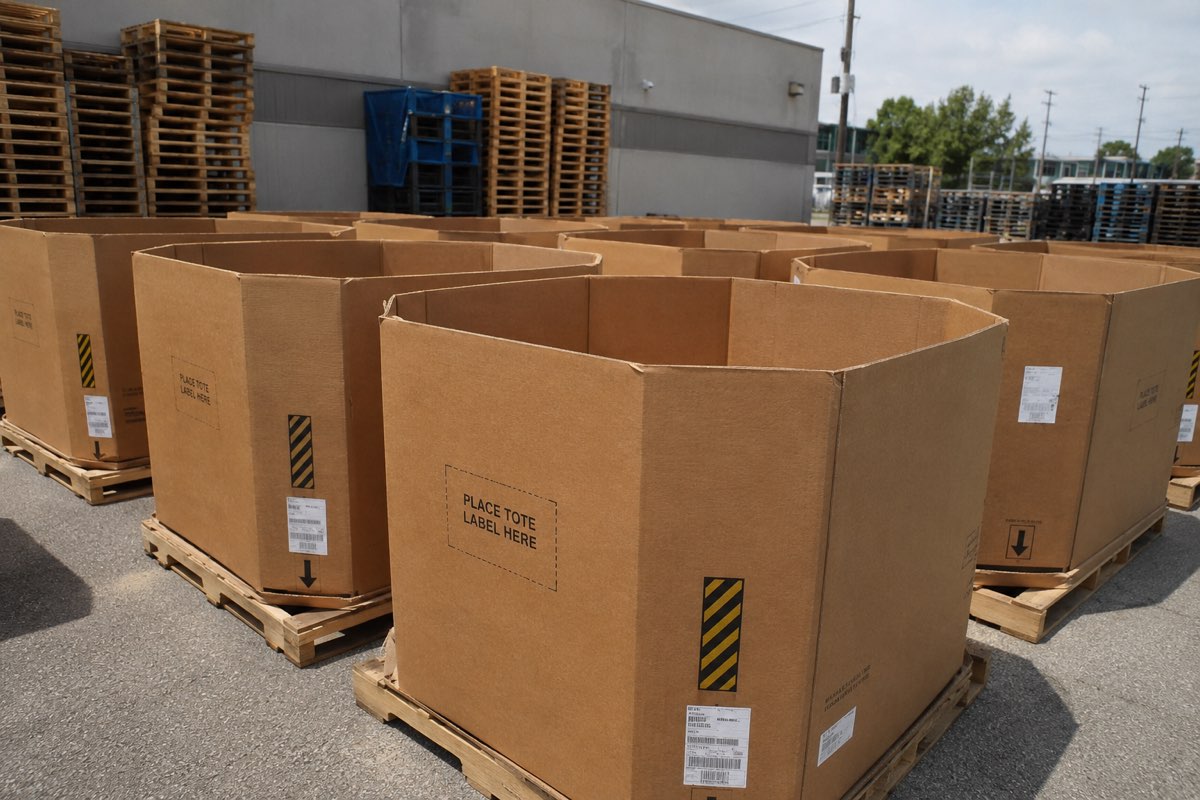
Every buyer asks the same question in the first email: is a used box actually as good? The answer is more interesting than yes or no, because 'as good' depends entirely on what the box has to survive between your dock and its destination.
What actually degrades when a box is used
Corrugated board gets its strength from geometry, not material. The fluted medium between two liners works like a series of arches: it resists compression because the flutes stand vertically and transfer load down the wall. Almost every failure mode you will ever see is a failure of that geometry, not of the paper.
- Flute crush — a forklift tine, a strap over-tightened, or a bad stack flattens the arches. Strength drops immediately and permanently.
- Moisture uptake — corrugated loses roughly half its compression strength at 90% relative humidity. Dry it out and most of that comes back; freeze it wet and it does not.
- Liner delamination — the glue line between liner and medium fails, usually from moisture or from being dragged loaded across concrete.
- Corner damage — corners carry the majority of a stacked load. A rounded, soft corner is worth far less than a scuffed flat wall.
Notice what is not on that list: cosmetics. Print bleed, ink transfer, scuffing, old labels and mismatched flap colours have precisely zero effect on how much weight a box will hold. A large share of what gets thrown away as 'damaged' is simply ugly.
The cost comparison, with real numbers
| New 1A | Grade A used | Grade B used | |
|---|---|---|---|
| Relative price | 100% | 35–55% | 20–35% |
| Trips remaining | 4–6 | 3–5 | 2–3 |
| Cost per trip | Lowest if you use all trips | Usually the lowest overall | Lowest for one-way moves |
| Lead time | 2–4 weeks typical | Same or next day from stock | Same day |
| Embodied CO₂e | ~13 lb per box | ~1.2 lb per box | ~1.2 lb per box |
The lead-time row matters more than most buyers expect. A new box order is a manufacturing run: you are in a queue behind whoever ordered before you, and corrugator schedules do not care about your production date. Used inventory sits on a yard. When a customer calls us on Tuesday needing 300 boxes for a Thursday load, used is not the cheaper option — it is the only option.
Where new boxes genuinely win
1. Direct food contact
If product touches fiber, the fiber needs a documented history. Used boxes do not have one that will satisfy an auditor. You can work around this with a food-grade poly liner inside a used box — and plenty of operations do exactly that — but if the box itself is the contact surface, buy new.
2. Regulated and hazardous material
UN-rated packaging is certified as a system: box, closure, liner and pallet together. A used box breaks the certification chain. There is no argument to have here.
3. When the box is the first impression
If a customer receives your product in a bulk box with somebody else's logo half-scrubbed off the side, that tells a story. Sometimes the story is fine — plenty of industrial buyers prefer knowing you did not burn money on packaging. Sometimes it is not. You know your customers.
The carbon side, without the theatre
Manufacturing a new tri-wall gaylord box consumes roughly 11–15 lb of virgin and recycled fiber, several gallons of process water, and produces on the order of 13 lb of CO₂e once you include pulping, corrugating, converting and freight to you. Reusing an existing box consumes a wash-down, an inspection, a repair patch and a short truck ride — call it 1.2 lb of CO₂e all-in.
That is roughly a 90% reduction, and unlike most sustainability claims it does not depend on an offset, a certificate or a projection. The box already exists. The emissions already happened. Every additional trip you get out of it divides those emissions by a larger number.
“Recycling a box is the second-best outcome. Reusing it is the best one. The industry spent thirty years celebrating the wrong number.”
How to decide in under a minute
- Does product touch the fiber, or is the shipment regulated? → New.
- Will an external customer see the box and judge it? → New, or Grade A with a clean face.
- Is it staying inside your building? → Grade B. Do not pay for looks you will not see.
- Is it a one-way scrap or debris move? → Grade C by the truckload.
- Everything else → Grade A used. This covers about 60% of real-world demand.
If you are unsure which grade your material needs, our Grade Decoder walks the same logic in six taps and gives you a spec you can paste into a purchase order.
Common questions on this topic
What is the short version of "Used vs. new gaylord boxes: the honest comparison"?
For most industrial uses, a Grade A used gaylord box does the same job as a new one at roughly 40% of the price with about 90% less embodied carbon. New boxes are worth the premium in exactly three situations: direct food contact, regulated chemical packaging, and shipments where the customer will judge you on the box.
Are these numbers specific to Houston and the Gulf Coast?
Several of them are, and we flag it where it matters. Corrugated loses roughly half its compression strength at 90% relative humidity, which is most of the year here, so a board rating buys you less on the Gulf Coast than the same rating buys inland.
Where do I go for a shorter answer?
The FAQ collects the questions that actually arrive in our inbox, the glossary defines every term used above, and the size chart has the raw capacities if that is all you came for.
Can you just specify a box for my situation instead?
Yes. The Grade Decoder turns six questions about your load, storage and audience into a wall count, grade and footprint, and the quote desk will sanity-check it against what is on the yard.
Do you cover this in more depth anywhere?
The Gaylord Box Guide is the long read that puts all of this in order, and the related field notes below go deeper on the adjacent topics.