The freight math nobody shows you: why the empty leg costs more than the box
A 53-foot trailer holds about 480 knocked-down 48×40×36 gaylord boxes. How to calculate landed cost per box, and why buying local beats cheap.
Have a question this raised?
Tell us what you have or what you need. A real person in Houston reads every one of these — usually within a couple of hours during dock time.
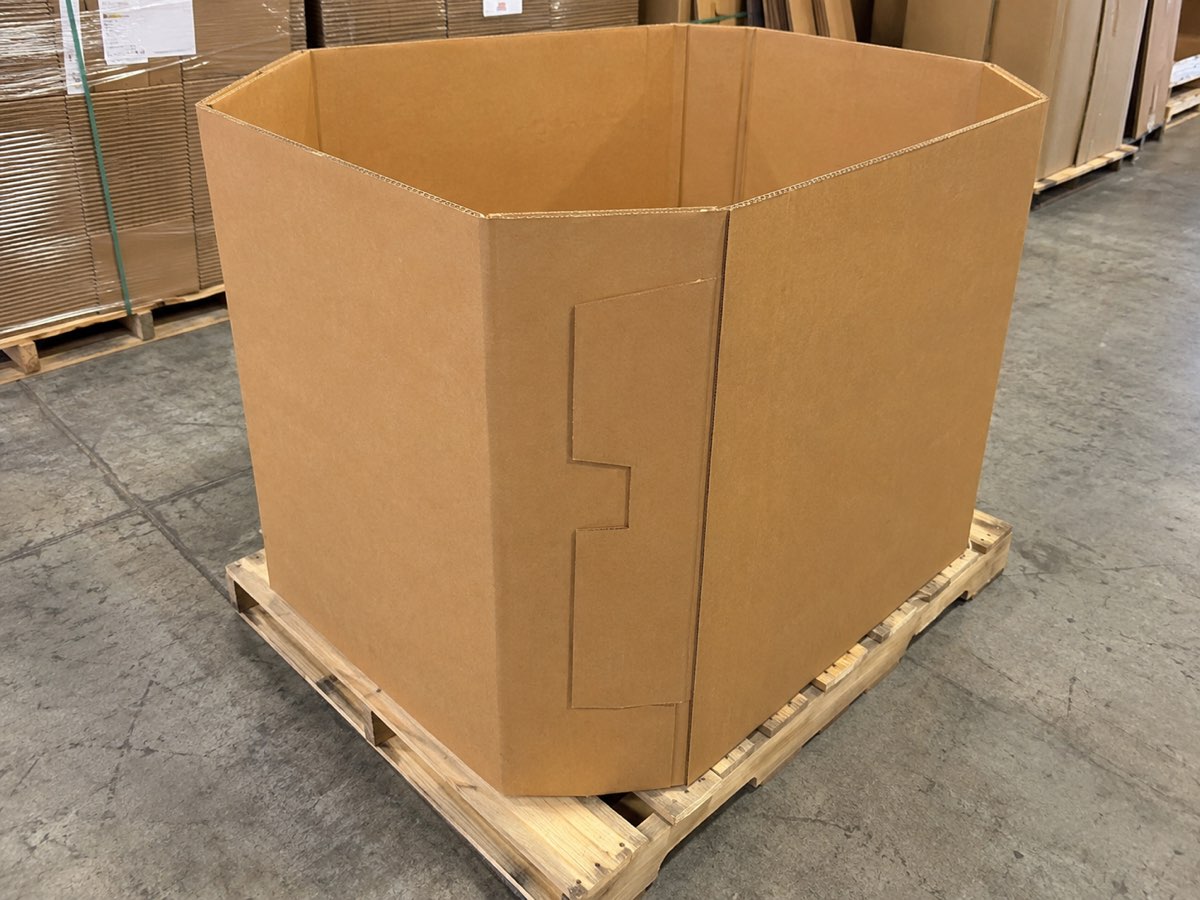
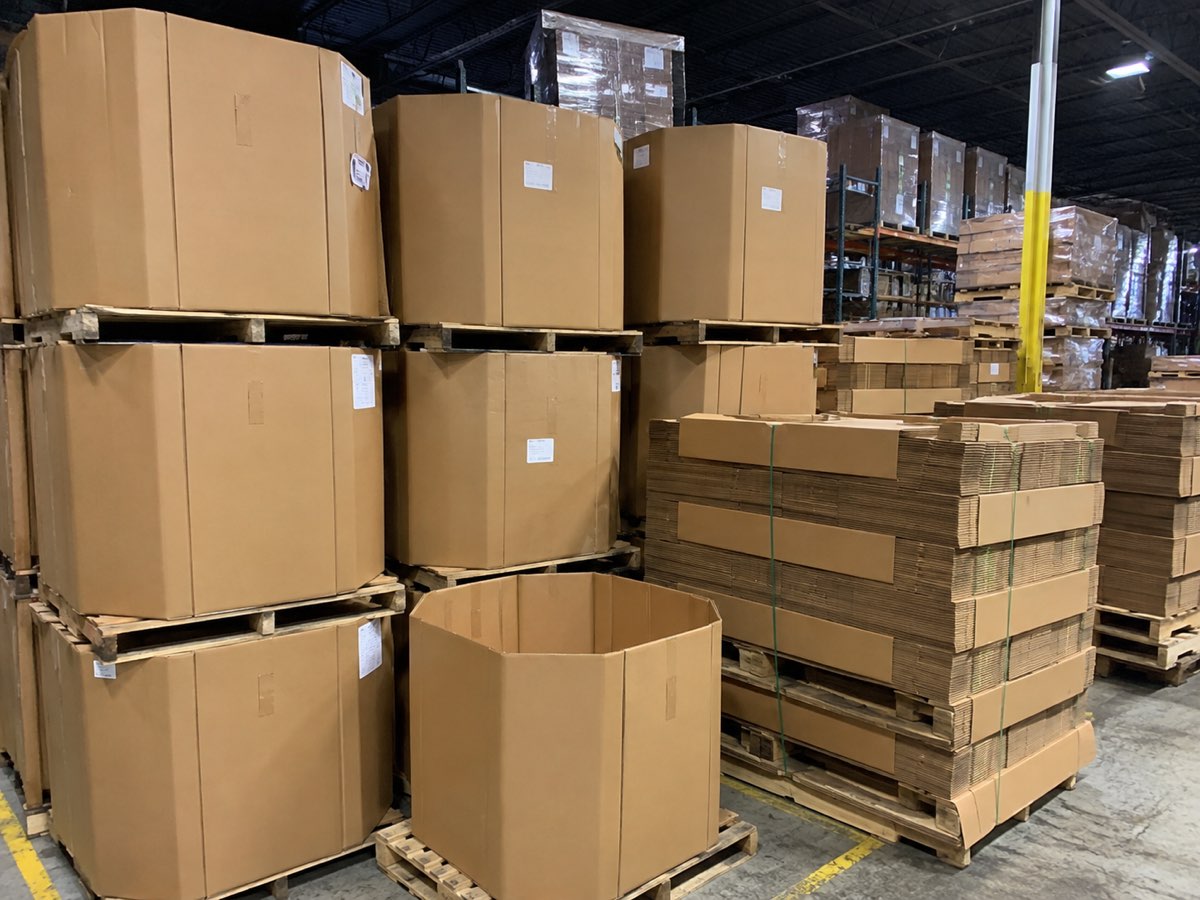
Buyers compare box prices. Controllers compare landed cost. The gap between those two numbers is freight, and in bulk corrugated it is enormous — often larger than the price of the boxes themselves.
Start with what fits on a truck
A standard 53-foot dry van gives you roughly 3,400 cubic feet of usable space, 26 standard pallet positions on the floor, and a 44,000–45,000 lb payload ceiling. Bulk corrugated never gets close to the weight limit, so every calculation here is a cube calculation.
| Configuration | Per 53' trailer | Notes |
|---|---|---|
| Knocked-down 48×40×36, banded flat | ~480 boxes | The standard way to ship used inventory |
| Knocked-down 48×40×30 | ~540 boxes | Shorter walls, more per bundle |
| Knocked-down 48×40×48 | ~360 boxes | Tall walls eat the cube fast |
| Assembled on pallets, single stack | 26 pallets | Only for pre-loaded or lidded boxes |
| Assembled, double stacked empty | ~52 boxes | Almost never worth the trailer |
| Half gaylords, knocked down | ~900 boxes | Best density in the catalogue |
The landed cost formula
Landed cost per box = (box price × quantity + linehaul + fuel + accessorials + your unloading labour) ÷ quantity. The two terms buyers forget are accessorials and labour, and they are the two that punish long-distance purchases hardest.
- Linehaul — roughly $2.20–$3.40 per mile for a dry van on Texas lanes, depending on season and direction.
- Fuel surcharge — typically 18–28% of linehaul, quoted separately, moves weekly.
- Detention — free time is usually two hours. Bulk corrugated unloads slowly if you are hand-stacking.
- Liftgate / driver assist — add $75–$200 if your dock cannot take a 53-footer or you need help.
- Your labour — unloading 480 knocked-down boxes by hand takes two people about three hours. That is real money.
A worked example
Two quotes for 480 used Grade A 48×40×36 boxes. Supplier A is in Houston at $11.50 per box. Supplier B is in Oklahoma at $8.75 per box.
| Local (45 mi) | Distant (480 mi) | |
|---|---|---|
| Box price × 480 | $5,520 | $4,200 |
| Linehaul | $310 | $1,440 |
| Fuel surcharge | $70 | $345 |
| Accessorials | $0 | $150 |
| Landed total | $5,900 | $6,135 |
| Landed per box | $12.29 | $12.78 |
The 'cheaper' box is 4% more expensive delivered — before you count the four extra days of lead time, the risk of a load arriving crushed, and the fact that you cannot send a truck back for twenty more boxes next Tuesday.
Backhaul is where the real money is
Here is the part most suppliers will not tell you: a truck that delivers boxes to you is going to leave empty unless someone fills it. If you have empty boxes, scrap corrugated, or pallets going out, that same trailer can take them. You pay one linehaul instead of two, and depending on the material we may pay you for the load.
This is why our standing-route customers pay noticeably less per box than our spot customers. It is not a loyalty discount — it is arithmetic. A round trip with paying freight in both directions costs each direction roughly 40% less.
Practical rules
- Always buy knocked-down unless the boxes are going straight into production the same shift.
- Ask for landed cost per box, not per-unit price. Any serious supplier will quote it.
- Order in trailer-sized increments. Half a trailer costs nearly the same as a full one.
- Pair every inbound load with an outbound one, even if it is just baled OCC.
- For anything under 100 boxes, buy local. LTL on bulk corrugated is brutal — the class rating punishes low-density freight.
Our Load Planner runs the trailer-fit half of this calculation instantly if you would rather not do it by hand.
Common questions on this topic
What is the short version of "The freight math nobody shows you: why the empty leg costs more than the box"?
Knocked-down gaylord boxes ship roughly 480 per 53-foot trailer; assembled boxes ship about 26 pallets, or 104–130 boxes. That 4:1 difference means freight, not box price, usually decides your landed cost — and it is why a box bought 400 miles away is rarely the cheap option it looks like.
Are these numbers specific to Houston and the Gulf Coast?
Several of them are, and we flag it where it matters. Corrugated loses roughly half its compression strength at 90% relative humidity, which is most of the year here, so a board rating buys you less on the Gulf Coast than the same rating buys inland.
Where do I go for a shorter answer?
The FAQ collects the questions that actually arrive in our inbox, the glossary defines every term used above, and the size chart has the raw capacities if that is all you came for.
Can you just specify a box for my situation instead?
Yes. The Grade Decoder turns six questions about your load, storage and audience into a wall count, grade and footprint, and the quote desk will sanity-check it against what is on the yard.
Do you cover this in more depth anywhere?
The Gaylord Box Guide is the long read that puts all of this in order, and the related field notes below go deeper on the adjacent topics.