33 questions, answered properly
Not a list of things we wished people asked. These are the questions that actually arrive in the inbox, grouped so you can find yours without scrolling through the others.
Get a written quote in one business day
Tell us what you have or what you need. A real person in Houston reads every one of these — usually within a couple of hours during dock time.
Basics
What is a gaylord box?
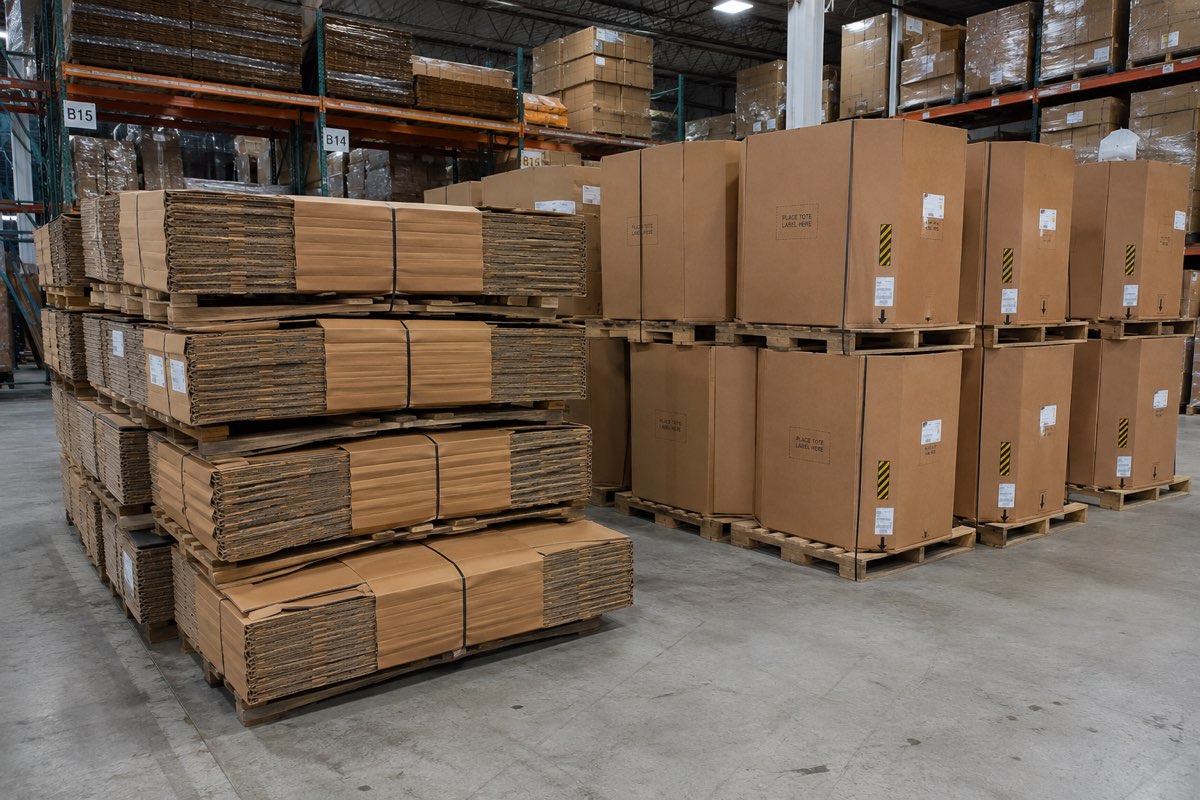
A gaylord box is a large, pallet-sized corrugated container used to ship and store bulk material. Standard footprint is 48" × 40" so it sits on a GMA pallet, with wall heights from 24" to 48" and wall counts from 2-wall to 5-wall. The name comes from the Gaylord Container Company, which popularised them in the 1950s — the term is now generic across the industry.
Why are they called gaylord boxes?
Gaylord Container Corporation of St. Louis was an early large-scale producer of pallet-sized bulk containers. The brand name became the generic term the way 'dumpster' and 'thermos' did. You will also hear bulk box, bulk bin, tote box, pallet box, skid box and octabin — mostly the same thing.
How much does a gaylord box hold?
A standard 48×40×36 holds about 33 cubic feet. Weight capacity depends on wall count: roughly 1,000–1,200 lb for 2-wall, 1,800–2,000 lb for 3-wall, 2,500–3,000 lb for 4-wall and 4,000 lb or more for 5-wall. Dense material almost always hits the weight limit long before the volume limit.
What is the difference between a gaylord box and an octagon bin?
An octagon bin has eight sides instead of four. That geometry distributes hoop stress rather than concentrating it in corners, so octagons hold their shape better under vibration and with free-flowing solids. They cost more, ship at a slightly lower density, and are the right answer for resin, grain, powders and anything that behaves like a liquid when it moves.
Buying
What is your minimum order?
One pallet — typically 20 to 40 knocked-down boxes depending on wall height — for local Houston delivery or pickup from our yard on E Richey Rd. There is no minimum at all for pickup. For deliveries beyond the metro we generally need a half trailer to make freight sensible.
Do you have boxes in stock right now?
Almost always for standard 48×40×36 and ×30 in Grades A, B and C — those are our deep-stock items and we typically hold several thousand. Tall walls, octagons, half gaylords and new 1A stock move in and out. Send the form with your size and quantity and you will get an actual current count, not a maybe.
How fast can I get boxes?
Same-day pickup from the yard if we have your spec in stock and you arrive during dock hours. Next-day delivery across most of the Houston metro. Two to four days for scheduled lanes to DFW, Austin, San Antonio and the Golden Triangle. New 1A boxes are made to order — two to four weeks depending on the corrugator schedule.
Can I see the boxes before I buy?
Yes. Come to the yard during dock hours and we will pull the exact lot you would be buying. For remote buyers we send photographs of the actual pallets, not stock images — including the ugly side.
Do you sell single boxes?
At the yard, yes. We are not going to turn anyone away for wanting four boxes. We just cannot deliver four boxes anywhere for a price that makes sense for either of us.
What payment terms do you offer?
Card or ACH on the first order. Net 30 available after that with a credit application for established businesses. Standing-route customers are invoiced monthly.
Selling
Will you buy my used gaylord boxes?
If they are dry, structurally sound and there are enough of them to justify a truck — generally 100 or more for a metro pickup, fewer if we are already running your area. We buy Grade A, B and C separately, and we buy mixed loads at a blended rate if you would rather not sort.
How much are used gaylord boxes worth?
It depends on wall count, size, grade and volume, and the market moves. As a rough guide, clean Grade A tri-wall boxes in truckload quantity are the most valuable, and the number drops sharply with each repair, each unit of moisture and each mile we have to drive. Send quantity, size, wall count and a photo and you will get a real number.
Do you pay for scrap cardboard too?
Yes — baled OCC is bought by the ton at the prevailing regional index, weighed on a certified scale with a ticket issued the same day. Loose corrugated we will take, but baled fiber is worth meaningfully more because it costs us far less to handle.
What condition do boxes need to be in?
Dry is the hard requirement. Beyond that we take almost anything: we grade on arrival and pay by category. What we cannot take is wet, mouldy, pest-infested, wax-coated or chemically contaminated fiber.
Do you charge to pick up?
Not on a paying load. If the material has value we cover the freight out of the purchase. If you are asking us to remove material that has no value — soaked boxes, contaminated fiber, mixed debris — there is a haul charge, and we will tell you the number before we roll.
Specs & sizes
What is the standard gaylord box size?
48" × 40" × 36" is the default and by far the most common. It matches the GMA pallet footprint exactly, which is why it exists in that dimension. The next most common are 48×40×30 for dense material and 48×40×42 for light bulky material.
Are gaylord box dimensions inside or outside measurements?
Almost always inside dimensions (ID), because what matters is what fits in the box. Outside dimensions run roughly ½" to 1½" larger per side depending on wall count — a 5-wall box has noticeably thicker walls than a 2-wall. If a dimension matters for racking or trailer fit, ask for OD explicitly.
How many gaylord boxes fit in a 53-foot trailer?
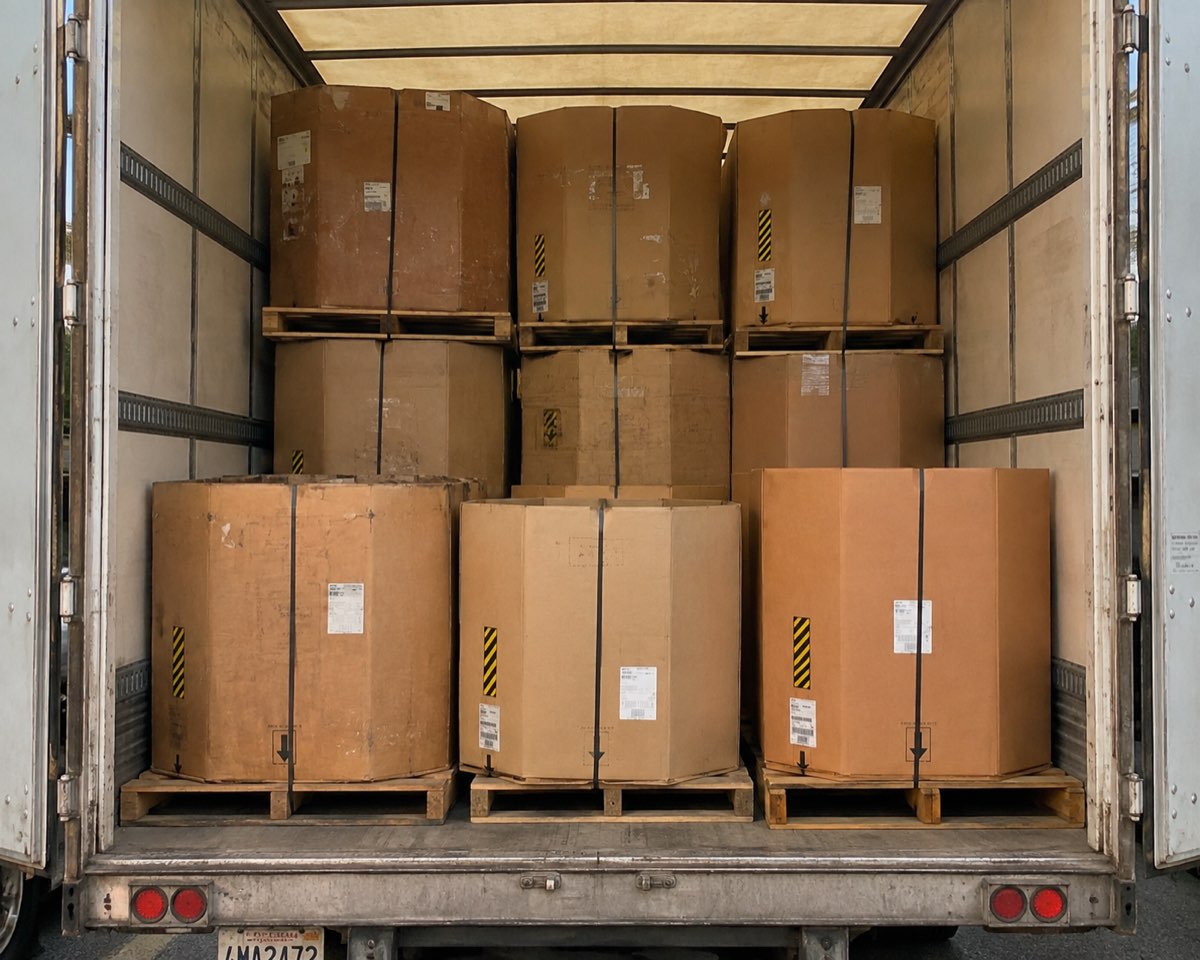
About 480 knocked-down 48×40×36 boxes, or 26 pallets of assembled ones. Shorter walls ship more per trailer, taller walls fewer. Half gaylords knocked down get you to roughly 900. Our Load Planner does this calculation for any size in our catalogue.
What does wall count mean?
It is the number of fluted layers in the board. More flutes means more compression strength, roughly linearly up to four walls. 3-wall — often called tri-wall — is the workhorse and handles the large majority of industrial applications.
Can gaylord boxes be stacked?
Yes, within limits: 2 high for 2-wall, 2–3 high for 3-wall, 3 high for 4-wall and 3–4 high for 5-wall, assuming corner-to-corner alignment, no pallet overhang, dry conditions and short duration. Every one of those assumptions matters — a misaligned stack in a humid warehouse loses strength fast.
Sustainability
Are used gaylord boxes actually more sustainable?
Yes, and it is not a close call. Manufacturing a new tri-wall box produces roughly 13 lb of CO₂e; putting an existing box back into service costs about 1.2 lb including inspection, repair and local freight. That is roughly a 90% reduction, with no offsets, certificates or projections involved. The box already exists.
What happens to boxes you cannot resell?
They are stripped of metal and plastic, baled as OCC grade #11 or #12 and sold to regional containerboard mills where they become new liner within about three to five weeks. Nothing structurally recoverable goes to landfill from our yard.
How many times can a gaylord box be reused?
Realistically three to six trips for a box that starts new and is handled well. The variables that matter most are moisture exposure, whether boxes are knocked down promptly, and where people cut them open. Fifteen minutes of dock training reliably adds about a trip and a half to average box life.
Can you provide sustainability reporting?
Yes. Standing-route and closed-loop customers get monthly statements showing pool size, trips per box, attrition, tons of fiber diverted and estimated CO₂e avoided, with the calculation methodology attached so your ESG team can audit it rather than take our word for it.
Logistics
Do you deliver outside Houston?
Yes — scheduled lanes to Dallas–Fort Worth, Austin, San Antonio, Beaumont and Port Arthur, plus the whole Gulf Coast. Metro Houston is next-day; the longer lanes run on planned routes, which is how we keep the freight cost per box reasonable.
Do boxes ship assembled or flat?
Flat (knocked down) by default, because it costs roughly a quarter as much per box to ship. Assembled delivery is available locally when boxes go straight into production the same shift.
What are your dock hours?
Monday to Friday 7:00 AM to 5:00 PM Central, Saturday 8:00 AM to 12:00 PM. Closed Sunday. If you need a load out before 7 AM, tell us on the quote and we will stage it the night before.
Can you handle a full warehouse cleanout?
Yes. Mixed boxes, pallets, loose corrugated, the lot. We sort on site or back at the yard, buy what has value, credit it against the haul, and give you a single settlement with weights and grades documented.
Working with us
Why don't you have a phone number?
Deliberate. Every quote we issue is in writing, with sizes, grades, quantities, freight and terms on one page you can forward to purchasing. Phone quotes get misremembered and re-litigated. Send the form and you get a document instead of a conversation you have to reconstruct from memory.
How fast do you respond?
Within one business day, usually within a couple of hours during dock time. Requests that come in Friday afternoon get answered Monday morning unless you flag them as urgent in the message field.
Do you offer custom fabrication?
Yes — dividers, partitions, layer pads, custom-height boxes, cut-down bins, display bases and one-off inserts, made from graded used board where the application allows it and new board where it does not.
Can I set up a standing order?
Yes, and standing-order customers get better pricing because we can plan trailers instead of scrambling for them. Weekly, biweekly and monthly cadences are all normal. Volume is adjustable with a week's notice.
Do you work with brokers and resellers?
Yes. Tell us in the message field that you are reselling and we will quote accordingly, including drop-ship to your customer with your paperwork on the load.