Pallet fit, load height and how many boxes actually fit a trailer
Freight regularly costs more than the boxes in this business. The two decisions that move that number most are whether boxes ship flat and whether they sit on the right pallet.
Get a written quote in one business day
Tell us what you have or what you need. A real person in Houston reads every one of these — usually within a couple of hours during dock time.
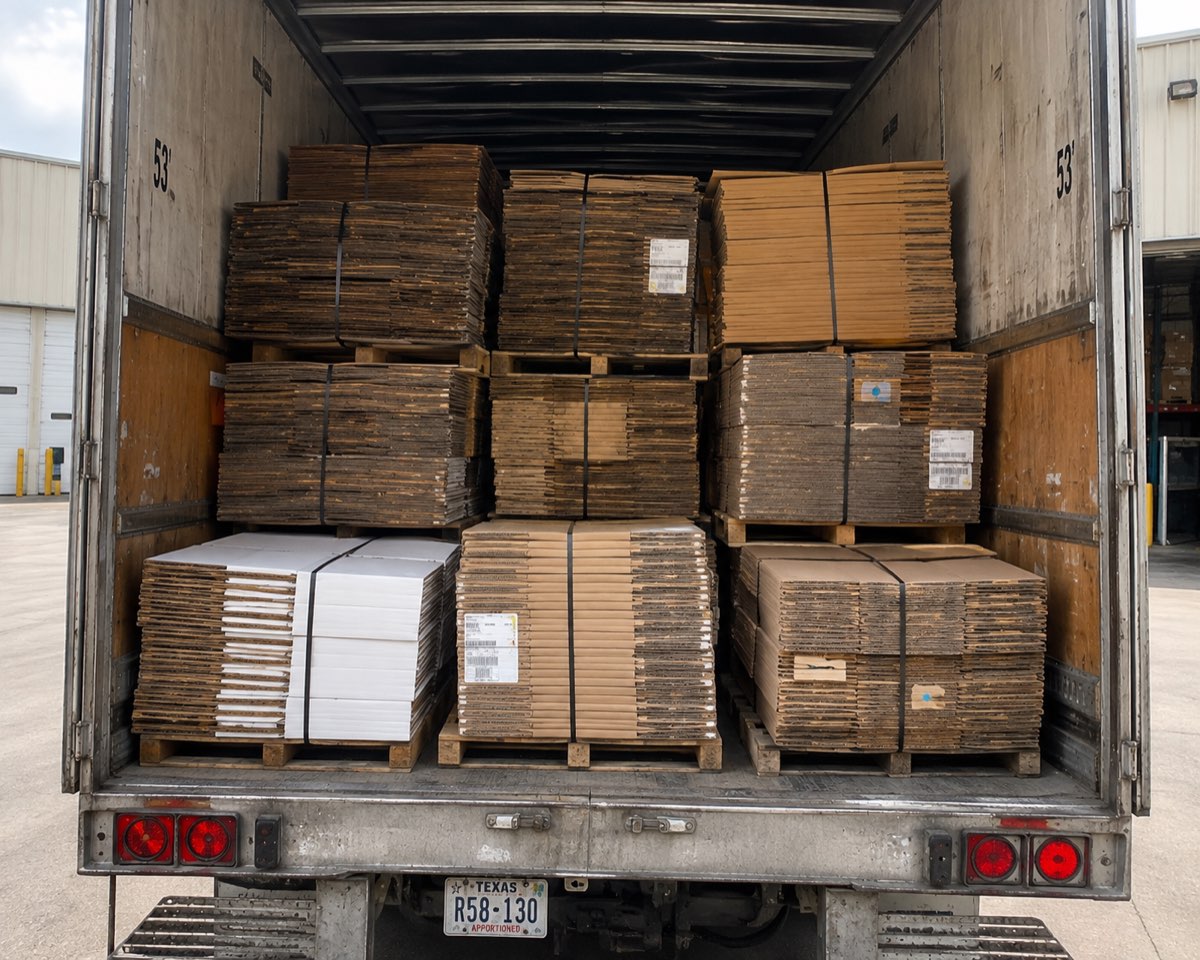
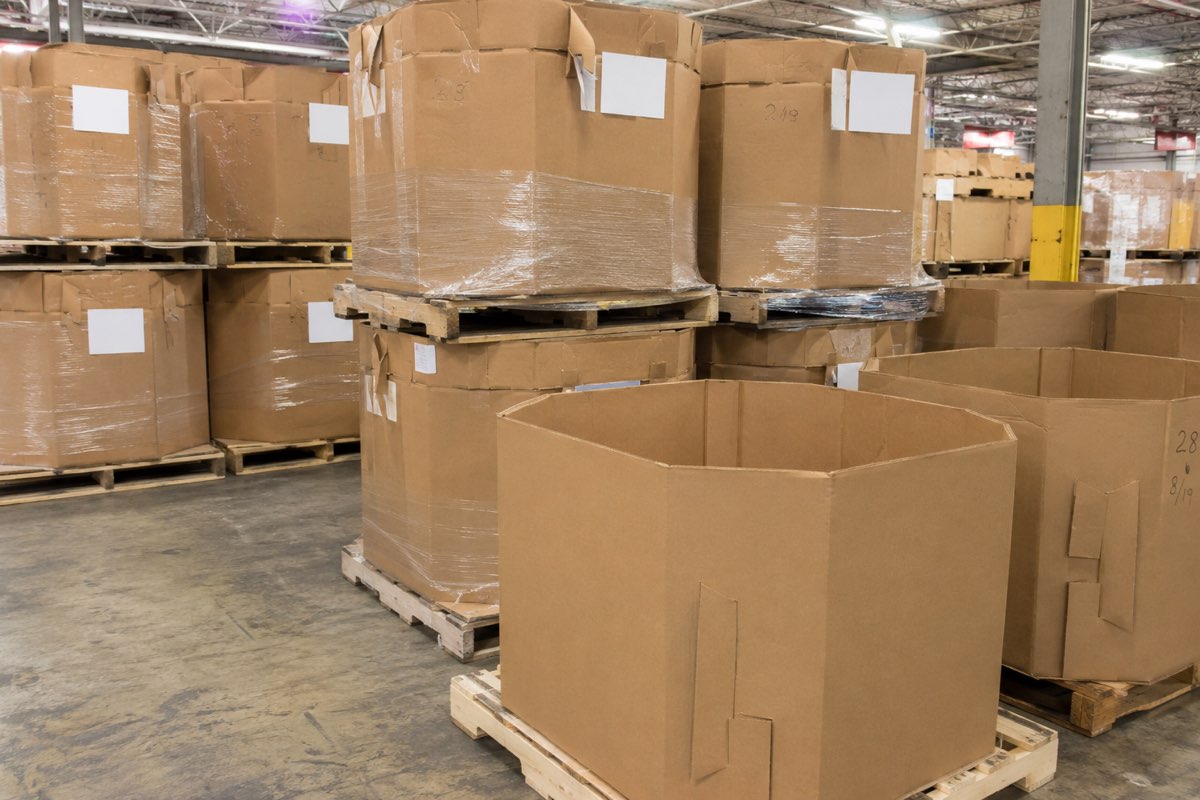
The trailer, in numbers
A standard 53-foot dry van gives roughly 3,400 cubic feet of usable space, 26 standard pallet positions on the floor in a two-across pattern, an interior height of about 110 inches, a door opening around 105 inches, and a payload ceiling of 44,000–45,000 lb.
Bulk corrugated never approaches that weight ceiling. Every calculation on this page is a cube calculation, which is why knocked down versus assembled is the single biggest lever on your freight cost.
Knocked down versus assembled
| Configuration | Per 53′ trailer | Relative freight per box |
|---|---|---|
| Knocked down, banded flat | ~480 (48×40×36) | 1.0× |
| Assembled, single stack on pallets | 26 pallets = 26 boxes | ~18× |
| Assembled, double stacked | ~52 boxes | ~9× |
| Assembled, nested where geometry allows | 80–110 boxes | ~5× |
Counts by size
Knocked-down counts for every size we stock, banded in bundles sized for a standard forklift:
| Size (ID) | Volume | Per 53′ KD | Pallet |
|---|---|---|---|
| 48″ × 40″ × 36″ | 40 cu ft | 480 | 48" × 40" GMA |
| 48″ × 40″ × 30″ | 33.3 cu ft | 540 | 48" × 40" GMA |
| 48″ × 40″ × 24″ | 26.7 cu ft | 600 | 48" × 40" GMA |
| 48″ × 40″ × 42″ | 46.7 cu ft | 420 | 48" × 40" GMA |
| 48″ × 40″ × 48″ | 53.3 cu ft | 360 | 48" × 40" GMA |
| 40″ × 48″ × 45″ | 50 cu ft | 390 | 48" × 40" GMA |
| 41″ × 28″ × 25″ | 16.6 cu ft | 900 | 48" × 40" GMA |
| 30″ × 30″ × 30″ | 15.6 cu ft | 1100 | 48" × 40" GMA |
| 45″ × 30″ × 45″ | 35.2 cu ft | 560 | 48" × 40" GMA |
| 47″ × 38″ × 44″ | 45.5 cu ft | 400 | 48" × 40" GMA |
| 48″ × 48″ × 40″ | 53.3 cu ft | 320 | 48" × 48" |
| 48″ × 40″ × 40″ | 44.4 cu ft | 400 | 48" × 40" GMA |
Pallet matching and overhang
Box footprint and pallet footprint must match. A 48 × 40 box goes on a 48 × 40 GMA pallet. A 48 × 48 square box goes on a 48 × 48 pallet — never on a GMA, no matter how convenient the GMA is.
Overhang removes support from the corners, and corners carry 60–70% of a stacked compression load. One inch of overhang costs roughly 20% of stacking strength. Two inches puts a three-high stack into territory where the bottom box is genuinely unsafe.
Load height planning
- Pallet deck height: about 5.5 inches for a standard GMA.
- Box outside height: wall height plus roughly 0.5 to 1.5 inches depending on wall count.
- Lid, if fitted: add 2 to 3 inches for a telescoping cap.
- Total that up and compare against 105 inches of door opening, not 110 of interior height.
A 36-inch box on a GMA pallet with a lid stands around 44 inches. Two stack to 88 inches, which clears comfortably. Three would be 132 and does not fit, which is why 36-inch boxes travel two high assembled.
Planning a mixed load
- Heaviest on the floor, always. Never put boxes of fiber under boxes of resin.
- Bundles banded to pallets, load-locked or strapped to prevent shifting. Corrugated that slides arrives crushed, and crushed is a grade lower than you paid for.
- Keep like sizes together so receiving can count without unbanding.
- Label each lot with size, wall count and grade on the outside of the bundle.
- Leave the nose of the trailer for anything going out last — usually accessories.
Smaller than a trailer
Under about 100 boxes, LTL is brutal on bulk corrugated because the freight class punishes low-density freight hard. Options in rough order of preference: pick up from our yard, wait for a scheduled lane in your direction, consolidate with a neighbouring facility, or accept the LTL number with your eyes open. We will quote all four rather than assume.
Loading questions
How many gaylord boxes fit in a 53-foot trailer?
About 480 knocked-down 48×40×36 boxes, or 26 pallets of assembled ones. Shorter walls ship more, taller walls fewer, and half gaylords get you to roughly 900.
Can boxes be double stacked in a trailer?
Assembled and empty, usually yes for shorter walls. Loaded, it depends entirely on the weight and wall count of the bottom box. Knocked down it is irrelevant — bundles stack to the ceiling.
What pallet does a 48×48 box need?
A 48×48 pallet. Putting one on a GMA leaves 8 inches of the box unsupported at two edges, which removes support from four corners.
Is LTL ever worth it?
Rarely for bulk corrugated — the freight class punishes low density hard. Under about 100 boxes, yard pickup or waiting for a scheduled lane almost always wins.