Things made from boxes that will never be boxes again
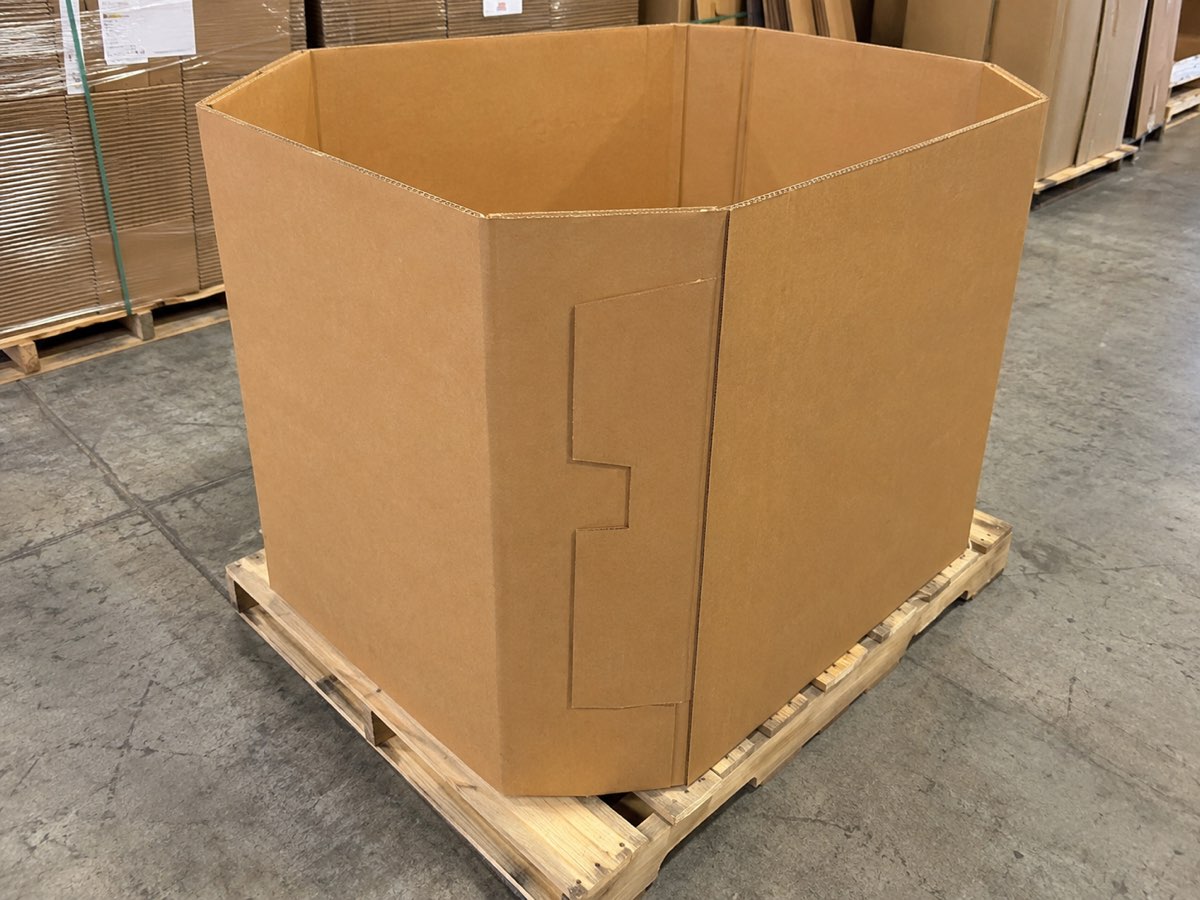
A wall panel with a blown corner is still twelve square feet of perfectly good tri-wall. Rather than baling it, we cut it into the dividers, pads and inserts most operations were quietly buying new.
Ask about upcycled goods
Tell us what you have or what you need. A real person in Houston reads every one of these — usually within a couple of hours during dock time.
At a glance
- Cell dividers
- 2- and 3-wall, cut and slotted to your grid
- Layer pads
- Die-cut square, standard and custom footprints
- Pallet caps
- Scored top sheets, all standard footprints
- Corner protectors
- Laminated L-profile
- Cut-down bins
- Shorter walls from top-band-damaged boxes
- Display bases
- Clean Grade A panels, retail and trade show
The standard shelf
These are items we keep cut or can cut same week from recovered stock. Everything below is available in standard 48×40-derived sizes and in custom dimensions where the recovered panels allow.
- Cell dividers and partitions — separating parts, glass, bottles and components inside a bulk box.
- Layer pads — between stacked layers, distributing weight and stopping product-to-product contact.
- Pallet caps and top sheets — protecting a load top and enabling a second stack.
- Corner protectors — under banding, spreading strap pressure off the corner.
- Cut-down bins — a 36-inch box with top damage becomes a structurally sound 30 or 24.
- Display bases and plinths — from clean Grade A panels, for retail floors and trade shows.
- Sleeves and collars — four-sided bodies re-scored from recovered walls.
Why this is cheaper than it sounds like it should be
New-board dividers require a corrugator run, a die and a minimum order. Recovered-board dividers require a cutting table and a stack of panels we already own. For short runs — 50 to 500 pieces — the difference is not marginal, it is a different order of magnitude.
Custom work
Send dimensions, quantity, what goes in it and how it is handled — a phone photo of a sketch is completely adequate. For anything unusual we make one, photograph it with a tape measure in frame, and adjust before cutting the run.
The carbon argument, since it comes up
Fabricating from recovered board avoids the pulping, corrugating and converting energy of new board entirely. It also delays the fiber's return to the mill by one more product life, which matters because corrugated fiber only survives five to seven pulping cycles before the fibers are too short to bond. Every product life extracted before repulping is a cycle you did not spend.
Upcycled Goods — common questions
Is upcycled board as strong as new?
Recovered board that passes inspection retains its original flute geometry and its original strength. We reject board with crush, moisture history or delamination regardless of how good the flat area looks.
Can you make one-offs?
Yes, genuinely — some of our best standing jobs started as a single strange cradle for a single strange part.
What is the lead time?
Prototypes usually within a week, production runs one to two weeks. Considerably faster than new-board tooling.
Do these look recycled?
Yes. They look like recovered board — mixed colours, occasional print. For a lot of buyers that is the point; if you need uniform appearance, say so and we will quote new.