The ship channel packaging economy, from a yard on Richey Road
Why the largest petrochemical cluster in the western hemisphere makes Houston the densest bulk corrugated market in Texas, and what that means.
By Tom Brennan, Founder · 7 min read · Published May 12, 2026
Have a question this raised?
Tell us what you have or what you need. A real person in Houston reads every one of these — usually within a couple of hours during dock time.
- Why the volume is here
- What density gets you
- What density costs you
- The geography that actually matters
- The seasonal rhythm
- Why we stayed on this side of town
Houston generates and consumes more bulk corrugated than any other Texas market because resin, chemicals and imports all move through the ship channel in boxes. That density means better availability, more competitive pricing and a wider grade range here than anywhere else in the state — and an unusually strong seasonal and cyclical pattern.
- Category
- Houston & Texas
- Published
- May 12, 2026
- Written by
- Tom Brennan, founder
We are on E Richey Road, off I-45 north, about twenty minutes from the top of the ship channel. That location is not sentimental. It is the reason this business works the way it does.
Why the volume is here
The Houston ship channel anchors the largest petrochemical cluster in the western hemisphere. Almost every pound of resin compounded, coloured, reground or purged along it spends part of its life in a bulk box. Add the port's import volume — components, ingredients, finished goods, all arriving in containers full of boxes — and you have a market that both generates and consumes bulk corrugated at a scale nowhere else in Texas matches.
That density has consequences for anyone buying boxes here, and most of them are good.
What density gets you
- Availability. Same-day pickup on standard sizes is realistic here in a way it is not in a thinner market.
- Grade range. Enough volume flows through that A, B and C are all genuinely available rather than theoretical.
- Competitive pricing. Several serious operators, which keeps everybody honest.
- Short freight. Most of the metro is a same-day round trip, and freight is usually the biggest line on the invoice.
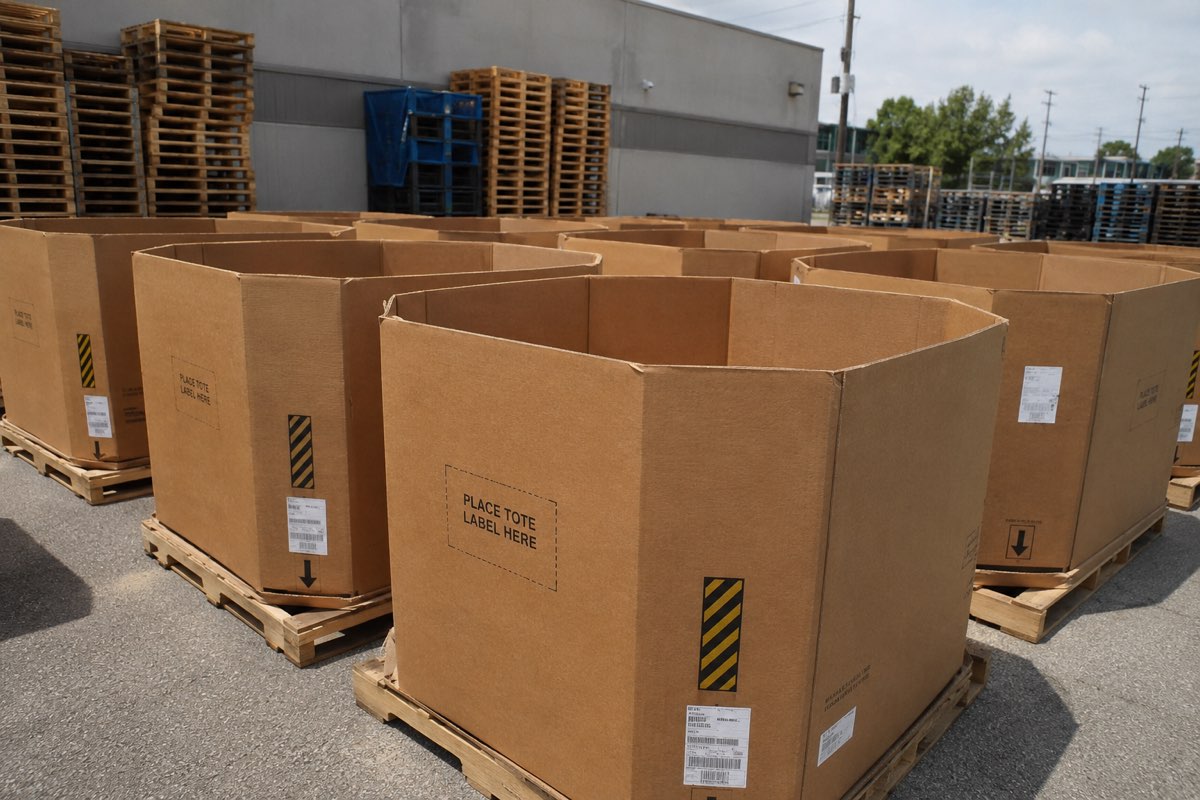
- Odd sizes. Import boxes, metric footprints, octagons — things you would wait weeks for elsewhere turn up here regularly.
What density costs you
- Volatility. When the petrochemical cycle turns, several facilities wind down within months of each other and the market goes from tight to loose in a quarter.
- Weather concentration. A single storm can take the whole metro's inventory out at once, and everybody reorders in the same week.
- Grade drift. High volume tempts suppliers to grade loosely because it moves faster, which is why a written standard matters more here than in a quieter market.
The geography that actually matters
| Area | What comes out of it | Delivery reality |
|---|---|---|
| Ship channel east (Pasadena, Deer Park) | Heavy dense loads, chemical, resin | Gate procedures and trailer queues drive the cost |
| North (Spring, Conroe, The Woodlands) | Light manufacturing, medical, distribution | Cleanest returns we see; newer docks |
| West (Katy, Brookshire) | Distribution, e-commerce, 3PL | Volume spikes hard after every promo cycle |
| South (Pearland, Alvin) | Mixed industrial, service companies | Smaller lots, more frequent pickups |
| Golden Triangle (Beaumont, Port Arthur) | Refining, agriculture, marine | Scheduled routes; needs full loads to work |
The seasonal rhythm
Three overlapping cycles run here. The petrochemical cycle sets how much material is moving and therefore how many boxes are generated. Hurricane season sets risk and inventory strategy from June to November. And the general retail and distribution calendar drives the west-side warehouses independently of both.
Practically: February and late August are the calm windows. April is produce season pulling freight capacity onto I-35. September and October are storm-risk and pre-holiday at once. Buying against that rhythm rather than with it is one of the few free savings available.
Why we stayed on this side of town
We moved here from a rented bay off Rankin Road in 2013 for one reason: from E Richey, a truck reaches Harris County, Montgomery County and the ship channel without touching the 610 loop at rush hour. That decision has done more for our freight costs than any negotiation since, and it is why same-day pickup is a real offer rather than a marketing line.
- Grade (box)
- A condition classification for used boxes. 1A new, A one clean use, B up to two repairs, C multiple repairs, then scrap.
Tom Brennan — Founder
Written on the yard at 1050 E Richey Rd, Houston. Everyone who writes here works the grading line, the baler, the routes or the quote desk — there are no guest posts and nothing on this blog is syndicated.