How to read a box maker's certificate without being lied to
The stamp on the bottom flap tells you what the board was rated at, not what your box will hold. What each number really means.
By Marisol Vega, Grading line lead · 7 min read · Published September 12, 2023
Have a question this raised?
Tell us what you have or what you need. A real person in Houston reads every one of these — usually within a couple of hours during dock time.
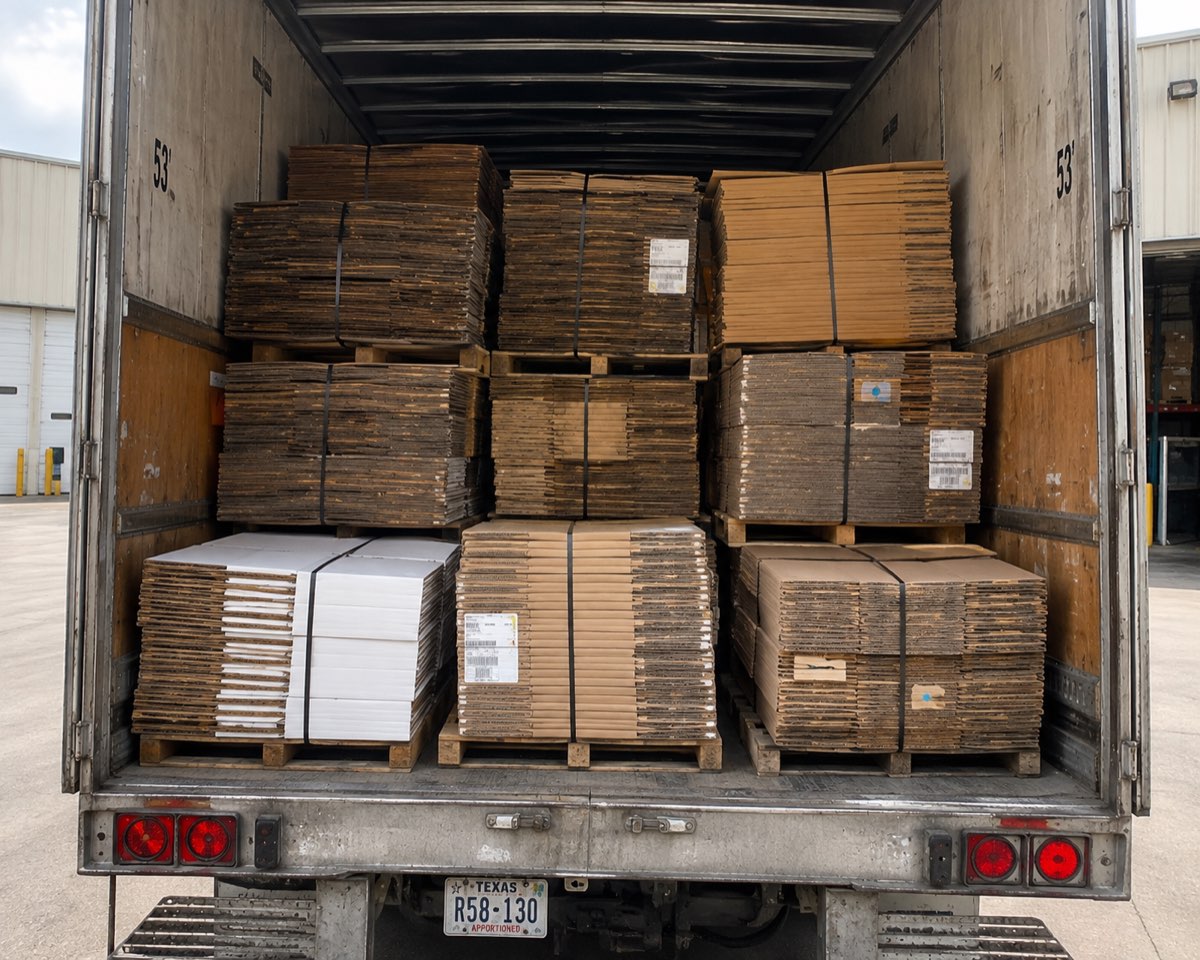

- What is actually printed there
- ECT versus Mullen, and why the industry moved
- The McKee formula, briefly
- The four things the stamp will never tell you
- What this means for used boxes
- How to use the certificate properly
A box maker's certificate reports either an edge crush test value (ECT, in pounds per inch) or a Mullen burst value (in pounds per square inch), plus the maximum gross weight and size limit. ECT predicts stacking performance; Mullen predicts puncture resistance. Neither figure survives moisture, long storage or misalignment, and the certificate does not mention any of them.
- Category
- Specification
- Published
- September 12, 2023
- Written by
- Marisol Vega, grading line lead
Every new box carries a round stamp on a bottom flap. Most buyers glance at it once and never think about it again, which is a shame, because it is the only piece of hard data that ships with a container.
What is actually printed there
- The manufacturer's identity and plant.
- Either an ECT value (edge crush, lb per inch) or a Mullen/burst value (lb per square inch) — usually one or the other, not both.
- Maximum gross weight of contents.
- Size limit: the sum of length, width and depth in inches.
- Sometimes the board grade and flute profile.
ECT versus Mullen, and why the industry moved
Mullen burst is the older test. A rubber diaphragm pushes through the board until it ruptures, and the pressure at rupture is the number. It measures how hard the board is to puncture — genuinely relevant if your material has corners that want to come through a wall.
ECT compresses a small section of board on its edge until it buckles. It measures the thing that actually happens in a warehouse: a stack of boxes pressing down on the box at the bottom. Since the 1990s most of the industry has moved to ECT because it correlates far better with real stacking failure.
| Test | Measures | Predicts | Reported as |
|---|---|---|---|
| ECT | Edge compression | Stacking strength | lb per inch (e.g. 71 ECT) |
| Mullen | Burst resistance | Puncture resistance | lb per sq inch (e.g. 275#) |
If a supplier quotes you a Mullen number for a bulk container that will be stacked three high, they are answering a question you did not ask. Ask for ECT.
The McKee formula, briefly
Box compression strength can be estimated from ECT, board thickness and box perimeter. The relationship matters more than the arithmetic: perimeter hurts you, and it hurts you faster than an extra wall helps.
Practically, that means a 48 by 48 square box needs heavier construction than a 48 by 40 to carry the same load, because its perimeter is larger. Buyers who scale up a footprint and keep the same wall count are quietly downgrading their own packaging.
The four things the stamp will never tell you
- Moisture. Corrugated retains roughly half its dry compression strength at 90 percent relative humidity. On a Houston dock in August that is not hypothetical.
- Creep. Board deforms slowly under sustained load. Six months of weight is not six hours of weight — plan on around 60 percent of the short-term rating.
- Alignment. Ratings assume corner-to-corner stacking. Two inches off centre and the corners of the lower box are supported by a flat wall, which is not a structural element.
- Handling history. A box that took a forklift tine in the wall has lost flute geometry permanently, and no certificate anywhere records that.
What this means for used boxes
A used box carries the same certificate it was born with, and that certificate is now partly fiction. This is exactly why we grade rather than quote ratings on used stock. A Grade A box — one clean fill, no cuts, square corners, dry — performs within a few percent of its original rating. A box with a soft corner does not, regardless of what is printed on the flap.
When a used-box seller quotes you an ECT number, ask them how they verified it on that specific lot. The honest answer is that they did not, and the honest alternative is a published grading standard you can check yourself on your own dock.
How to use the certificate properly
- For new boxes, ask for ECT and keep the certificate on file — your auditor will ask for it, not for a sales sheet.
- Derate it: multiply by 0.7 for humid storage and by 0.6 for storage beyond three months. Apply both, not the worse one.
- Compare that derated number to the real weight of a full box times your stack height minus one.
- For used boxes, ignore the stamp and buy on a grading standard instead.
- Creep
- The gradual deformation of corrugated under sustained load. A box holding weight for six months carries roughly 60% of its short-term rating.
- ECT
- Edge Crush Test. Pounds per linear inch a board edge withstands before buckling. The best single predictor of stacking performance.
- Flute
- The wavy medium between liners. Its arch geometry is what gives corrugated its strength-to-weight ratio.
- Grade (box)
- A condition classification for used boxes. 1A new, A one clean use, B up to two repairs, C multiple repairs, then scrap.
- McKee formula
- An engineering estimate of box compression strength derived from ECT, board thickness and box perimeter.
- Wall count
- The number of fluted layers. 2-wall through 5-wall in common use.
Marisol Vega — Grading line lead
Written on the yard at 1050 E Richey Rd, Houston. Everyone who writes here works the grading line, the baler, the routes or the quote desk — there are no guest posts and nothing on this blog is syndicated.