What a bad bale actually costs you at the mill
Moisture, wax, food residue and metal are the four things that downgrade a bale of old corrugated. What each one does to the price.
By Luis Barrera, Yard supervisor · 6 min read · Published October 3, 2023
Have a question this raised?
Tell us what you have or what you need. A real person in Houston reads every one of these — usually within a couple of hours during dock time.
- The grade ladder
- 1. Moisture
- 2. Wax
- 3. Food residue and grease
- 4. Metal
- The bale itself matters too
- The order of operations that actually pays
A bale of recovered corrugated is priced on grade: #12 double-sorted OCC earns a premium, #11 is the baseline, mixed paper is well below, and a rejected bale is a disposal cost rather than revenue. The four things that move you down that ladder are moisture above mill spec, wax coating, food residue and metal left in the box.
- Category
- Sustainability
- Published
- October 3, 2023
- Written by
- Luis Barrera, yard supervisor
Everybody who bales corrugated eventually gets the phone call. The mill weighed your load, opened a bale, and now there is a conversation about grade. Here is what is behind that conversation.
The grade ladder
| Grade | Spec | Where the price sits |
|---|---|---|
| #12 Double-sorted OCC | Clean, sorted, ≤2% prohibitives, no other fiber types | Premium over baseline |
| #11 OCC | Baled corrugated, ≤5% prohibitives | The baseline everyone quotes |
| Mixed paper | Office paper, boxboard, magazines mixed in | Substantially below OCC |
| Rejected | Wet, waxed, food-soaked or metal-laden | A disposal cost, not revenue |
The gap between #11 and mixed paper is not a rounding error. On a 20-ton trailer it is the difference between a cheque worth having and a cheque that barely covers the freight.
1. Moisture
Mills specify a maximum moisture content, usually somewhere in the 12 to 14 percent range. Above that, they are paying OCC prices for water, and they will tell you so.
The common cause is not rain during transport — it is bales stored outside. A bale left in a Gulf Coast yard for a week in September gains weight, and every pound of that weight is a pound they discount. Bales belong under a roof, on pavement, off the ground.
2. Wax
Wax-coated corrugated — the produce boxes that survive an ice bath — does not repulp in a standard mill. The wax does not dissolve, it disperses through the batch and contaminates fiber that was otherwise fine. One waxed box in a bale is a problem out of all proportion to its size.
If your operation handles any produce packaging, wax segregation needs to happen at the point of emptying, not at the baler. By the time it reaches the baler nobody can find it.
3. Food residue and grease
Oil interferes with fiber bonding. Greasy fiber does not make strong liner, and mills know exactly what it looks like in a bale. This is why food-contact operations that want a fiber credit run liners: the liner takes the residue, the box stays clean, and both go to their own market.
4. Metal
This is the one that generates a phone call rather than a discount. Staples, banding, box cutters and the occasional forgotten wrench go into a hydrapulper and damage equipment. A mill that finds metal in your bales will reject the load, and if it happens twice they will stop buying from you.
The bale itself matters too
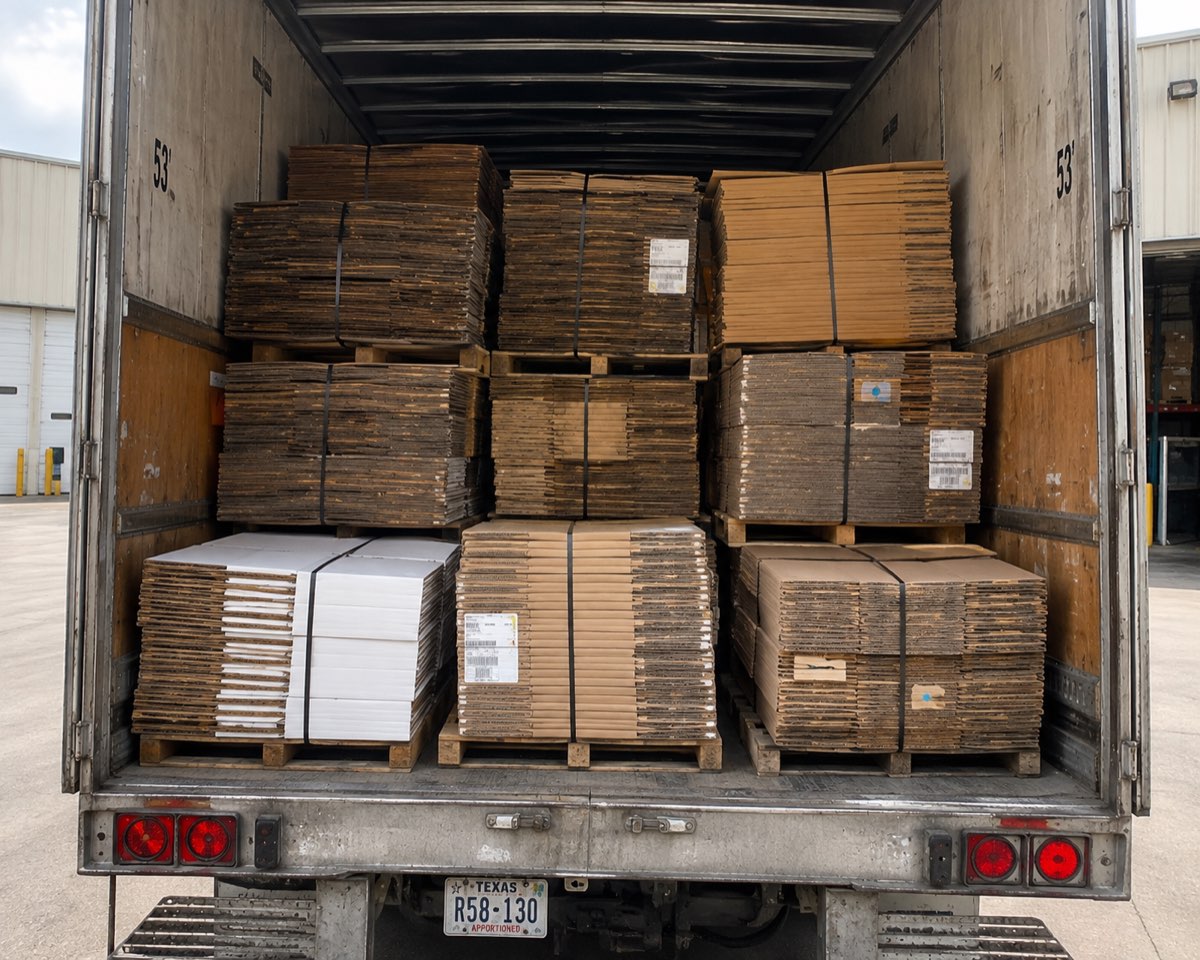
Density is a commercial variable most generators never think about. A loose bale wastes trailer space and costs the mill more per ton to handle, and they price accordingly. Mill-size bales in the 1,100 to 1,400 pound range, wire-banded and square, are what you are aiming for.
The order of operations that actually pays
- Grade first. Roughly a third of what arrives labelled scrap is still a working box worth several times its fiber value.
- Pull metal and plastic at prep, not at the baler.
- Segregate wax and wet at the point of emptying, by the person who just looked inside.
- Bale tight, band with wire, store under a roof.
- Weigh on a certified scale and take the ticket the same day. If your buyer settles at month end from their own numbers, you have no way to check anything.
- Bale
- A compressed, banded block of recovered corrugated, typically 1,100–1,400 lb. Mills buy fiber by the bale-load; density affects the price they pay.
- Double-sorted OCC (#12)
- A premium grade of recovered corrugated: clean, sorted, under 2% prohibitives, no other paper types mixed in.
- ECT
- Edge Crush Test. Pounds per linear inch a board edge withstands before buckling. The best single predictor of stacking performance.
- Grade (box)
- A condition classification for used boxes. 1A new, A one clean use, B up to two repairs, C multiple repairs, then scrap.
- Liner
- The flat facing sheets on either side of the fluted medium.
- OCC
- Old Corrugated Containers. The recovered-fiber commodity grade that used boxes become at end of life.
- Prohibitives
- Non-fiber contaminants in a bale — plastic, metal, wax, food residue. Mills specify maximum percentages by grade.
- Scrap
- A box that is no longer viable as a container. Still valuable — as fiber, by the ton.
Luis Barrera — Yard supervisor
Written on the yard at 1050 E Richey Rd, Houston. Everyone who writes here works the grading line, the baler, the routes or the quote desk — there are no guest posts and nothing on this blog is syndicated.