Texas freight lanes and the seasonal swings nobody warns you about
Houston to DFW, Austin, San Antonio and the Golden Triangle: how each lane behaves, when rates spike, and how to plan purchasing around it.
By Dwayne Okafor, Dispatch & freight · 7 min read · Published March 10, 2026
Have a question this raised?
Tell us what you have or what you need. A real person in Houston reads every one of these — usually within a couple of hours during dock time.
- The lanes we run, and how each behaves
- The seasonal pattern
- Hurricane disruption specifically
- Five things that reduce your freight cost
- What we will not do
Texas dry-van rates spike in produce season (spring), around hurricane events, and in the pre-holiday retail push. Houston–DFW is the deepest and steadiest lane; Houston–Golden Triangle is short and chronically imbalanced; I-35 lanes swing hardest with produce. Buying corrugated in February and August avoids most of it.
- Category
- Logistics
- Published
- March 10, 2026
- Written by
- Dwayne Okafor, dispatch & freight
Freight is usually the largest line on a bulk corrugated invoice, and it is the one buyers treat as fixed. It is not fixed. It has a season, and in Texas the season is fairly predictable.
The lanes we run, and how each behaves
Houston – Dallas/Fort Worth
About 240 miles, the deepest freight lane in the state, and consequently the most stable. Capacity is plentiful in both directions most of the year, which makes backhaul pairing genuinely easy — and DFW's enormous e-commerce footprint generates exactly the empty boxes a Houston processor wants next week.
This is the lane where our pricing gets closest to local, and it is entirely because the return leg is easy to fill.
Houston – Austin and San Antonio
Roughly 165 and 200 miles. These swing hardest, because I-35 carries produce north from the Valley and Mexico, and produce season takes capacity out of the market for everybody else.
March through May, expect I-35 rates to be noticeably higher and availability tighter. If your Austin plant needs boxes in April, order in February.
Houston – Beaumont / Port Arthur
Ninety minutes east, and chronically imbalanced. Lots of freight comes west out of the refining complex; less goes east. That means the eastbound leg — our delivery direction — is often cheap and the return is the challenge.
We run scheduled routes here rather than one-off trips specifically so volume consolidates and the return leg gets filled with fiber and empties.
Intra-Houston metro
Under 50 miles, priced by time rather than distance. The variables are dock hours, gate procedure and how long a driver waits. A plant with a two-hour gate queue is a more expensive delivery than one twice as far away with a clear dock.
This is why we ask about gate procedure on the quote. It is not paperwork, it is a real cost line.
The seasonal pattern
| Period | Rate direction | Driver |
|---|---|---|
| January–February | Soft | Post-holiday lull, capacity available |
| March–May | Firm to high | Produce season on I-35 and the Valley lanes |
| June–August | Moderate | Steady industrial demand; watch storm disruptions |
| Hurricane events | Spike, regionally | Capacity diverted, lanes closed, recovery demand |
| September–November | Rising | Pre-holiday retail push |
| December | Mixed | Retail peak then a sharp drop after mid-month |
Hurricane disruption specifically
A storm does three things to freight at once: it closes lanes, it diverts capacity to recovery and relief, and it creates a demand spike as everyone in the affected metro reorders in the same week.
For corrugated the compounding problem is that boxes are exactly what everybody needs after a flood, and corrugator lead time is still four weeks. This is why we hold deeper inventory through the season — not merchandising, just arithmetic.
Five things that reduce your freight cost
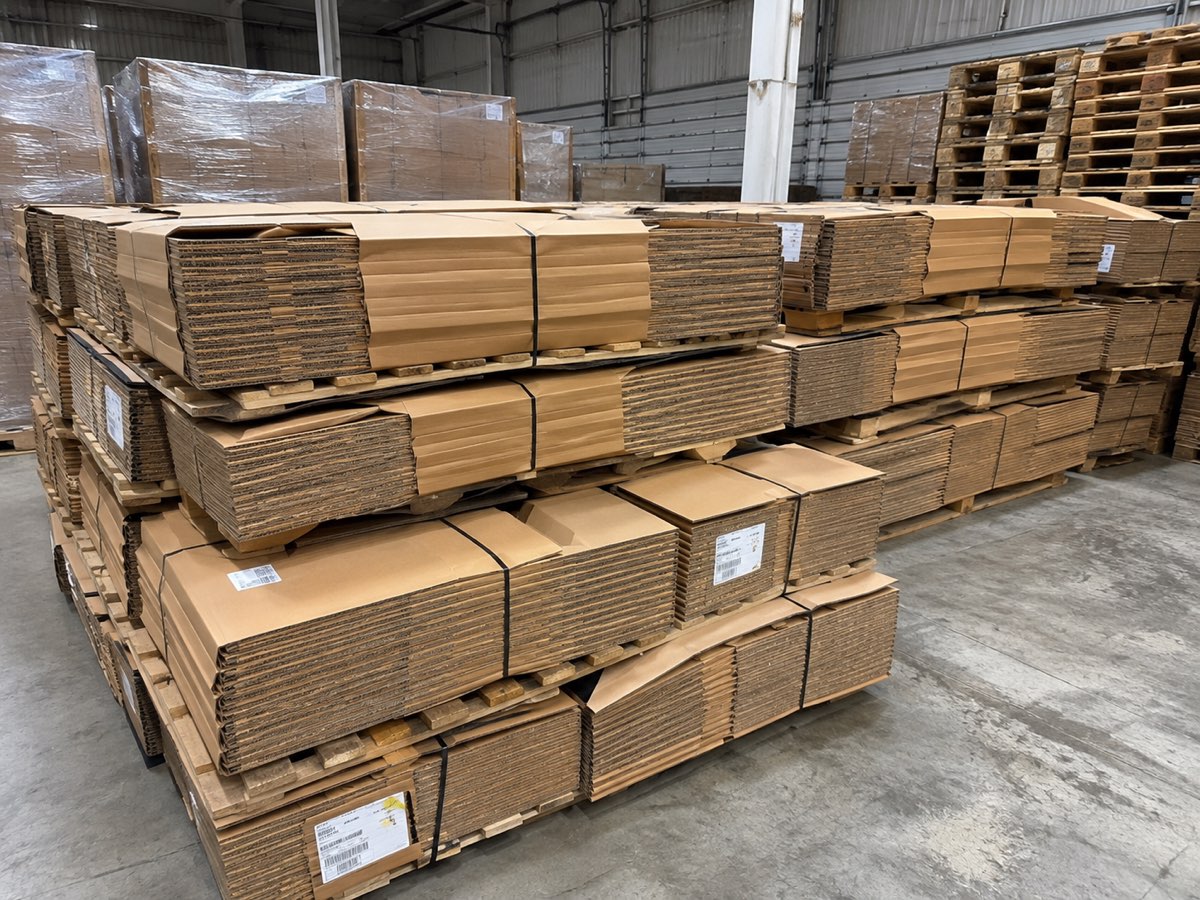
- Order knocked down. Roughly four times as many boxes per trailer as assembled.
- Pair every inbound load with an outbound one, even if it is only baled fiber. Roughly 40 percent off each direction.
- Order in trailer-sized increments. Half a trailer costs nearly the same as a full one.
- Buy in February and August rather than April and October.
- Fix your dock: clear gate procedure, known hours, a forklift available. Detention is a real line item and it is entirely within your control.
What we will not do
Quote you a lane we cannot serve well. Past roughly 400 miles, freight on bulk corrugated usually exceeds the value of the boxes, and recycling locally while buying graded stock near the destination is the better circular outcome anyway. We would rather say that than sell a bad freight number and lose the relationship on delivery day.
- Bale
- A compressed, banded block of recovered corrugated, typically 1,100–1,400 lb. Mills buy fiber by the bale-load; density affects the price they pay.
- Corrugator
- The machine — and by extension the plant — that glues fluted medium between liners to make corrugated board.
- ECT
- Edge Crush Test. Pounds per linear inch a board edge withstands before buckling. The best single predictor of stacking performance.
- Grade (box)
- A condition classification for used boxes. 1A new, A one clean use, B up to two repairs, C multiple repairs, then scrap.
- Knocked down (KD)
- Shipped flat rather than assembled. Roughly four times more boxes per trailer, which is why almost all used inventory ships this way.
Dwayne Okafor — Dispatch & freight
Written on the yard at 1050 E Richey Rd, Houston. Everyone who writes here works the grading line, the baler, the routes or the quote desk — there are no guest posts and nothing on this blog is syndicated.