Skip to content
GAYLORD BOXES TXHOUSTON · SINCE 2009
Logistics · July 16, 2024

Why your boxes arrive crushed, and whose fault it usually is

Crushed deliveries are almost always a securement problem, not a box problem. The five loading mistakes that cause them and what to write into your inbound requirements.

The short version: Bulk corrugated arrives crushed because it shifted in transit, not because it was too weak. The causes are unbanded bundles, no load locks, heavy freight stacked on light, gaps left in the load, and unloading with tines instead of a pallet. All five are securement decisions made at the origin dock.

By Dwayne Okafor, Dispatch & freight · 6 min read · Published July 16, 2024

Request a quote

Have a question this raised?

Tell us what you have or what you need. A real person in Houston reads every one of these — usually within a couple of hours during dock time.
US or Canada, 10 digits — area code first.

US state or Canadian province.

ZIP like 77073, or Canadian M5V 2T6.

Whole boxes. A rough number is fine.

No phone number required from us — we quote in writing so you have the numbers on paper. We never sell or share your details.

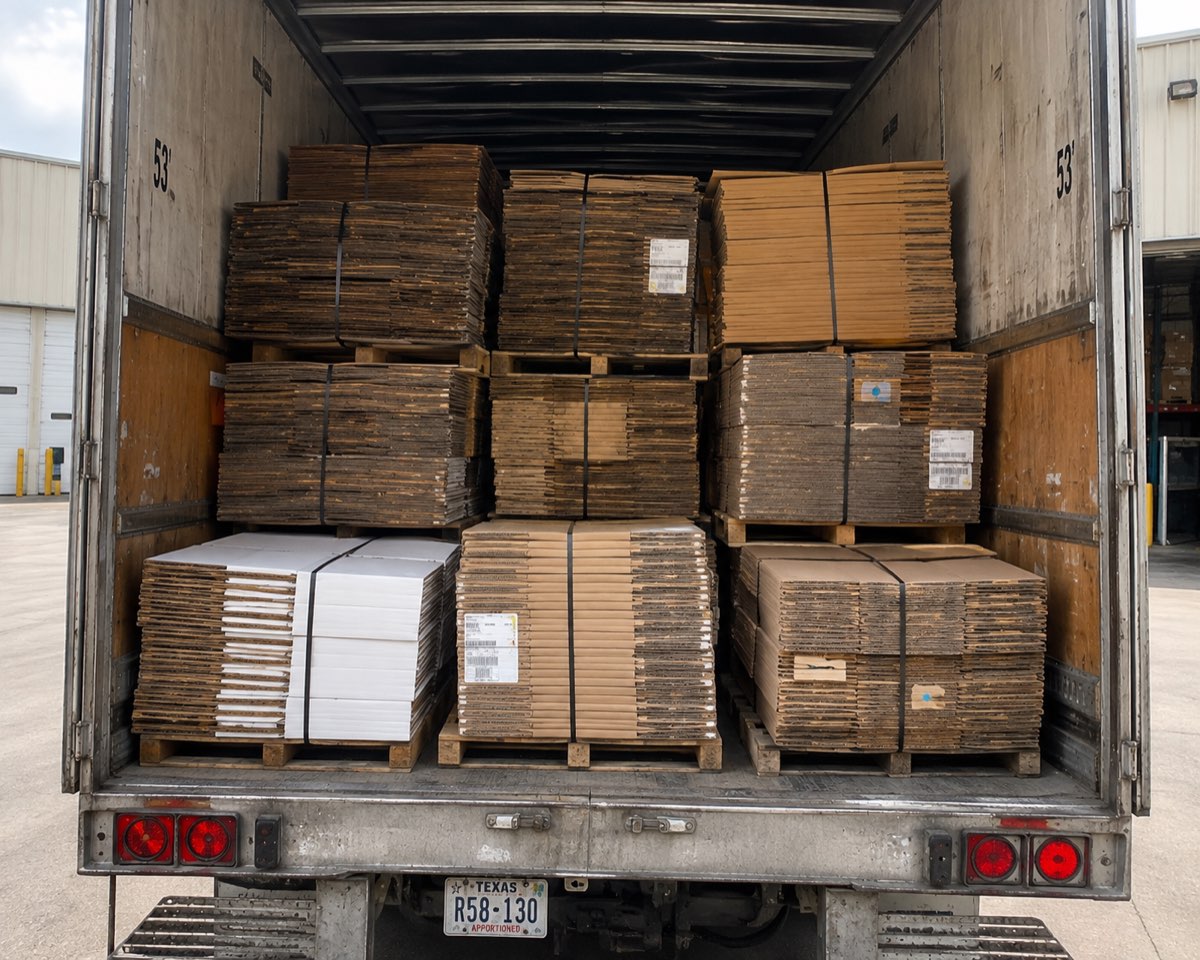
Rear view of a loaded box truck holding banded bundles of knocked-down boxes and assembled bins
Load-locked and banded. Corrugated that slides in transit arrives crushed.
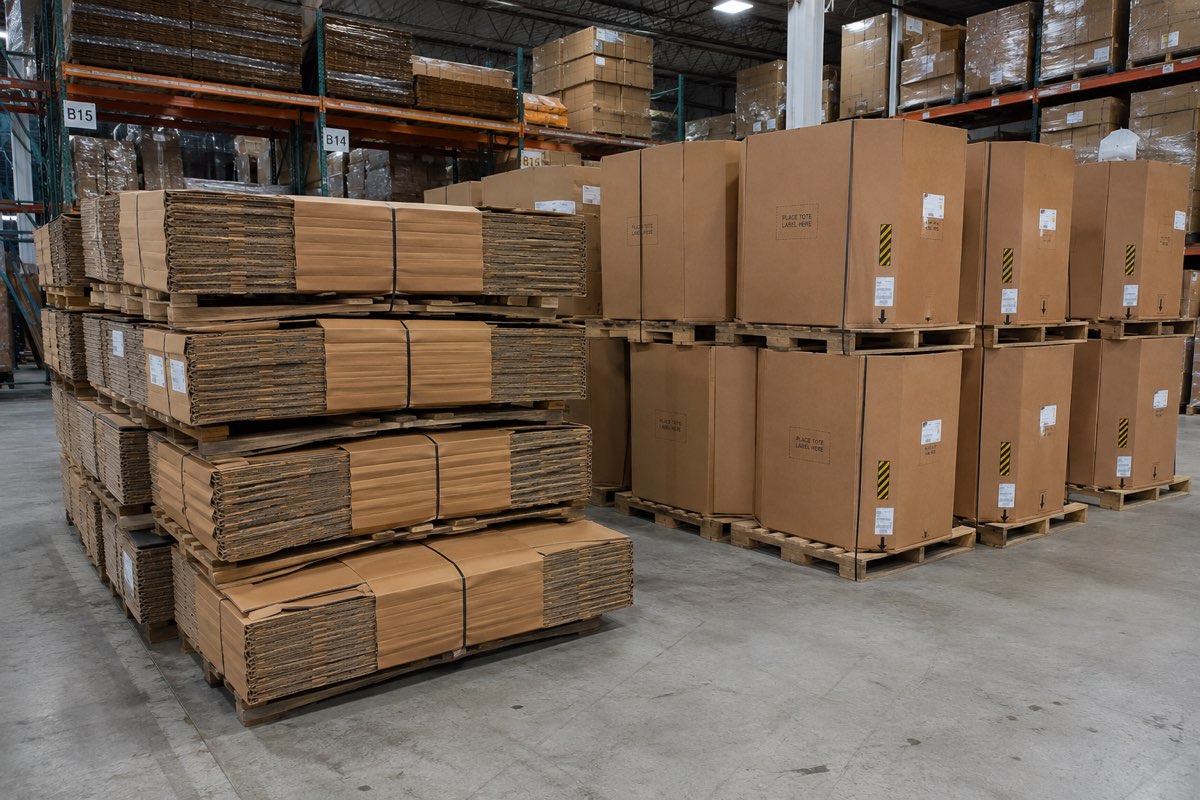
Flat banded bundles of knocked-down boxes on the left and assembled bulk bins on pallets on the right
Flat on the left, assembled on the right. The difference is most of your freight bill.
What this post covers
  1. Corrugated does not survive movement
  2. The five causes
  3. What to write into your inbound requirements
  4. When the boxes really were the problem
Key takeaway

Bulk corrugated arrives crushed because it shifted in transit, not because it was too weak. The causes are unbanded bundles, no load locks, heavy freight stacked on light, gaps left in the load, and unloading with tines instead of a pallet. All five are securement decisions made at the origin dock.

Category
Logistics
Published
July 16, 2024
Written by
Dwayne Okafor, dispatch & freight

A trailer arrives, the doors open, and the front third of the load has slumped. The customer's first thought is that the boxes were weak. Nine times out of ten the boxes were fine when they were loaded and something moved.

Corrugated does not survive movement

This is the fundamental point. Corrugated is strong in compression along the flute axis and weak against almost everything else. A bundle that slides two feet and stops against a wall has absorbed that whole deceleration through the edge of the board.

A trailer on a Texas interstate does not travel smoothly. There is longitudinal shock at every brake application, lateral loading at every ramp, and continuous vibration. The load has to be built so that nothing moves at all, because a load that moves a little will move a lot by the time it arrives.

The five causes

1. Unbanded bundles

Knocked-down boxes stacked loose on a pallet behave like a deck of cards. They need to be banded into bundles, and the bundles need to be banded or stretch-wrapped to the pallet. Loose flat board slides against itself with almost no friction.

2. No load locks or load bars

Corrugated is light. A trailer loaded to the cube with bulk boxes is nowhere near its weight limit, which means the load has very little inertia holding it in place. Load bars every few pallet positions cost a few minutes and prevent the entire failure mode.

3. Heavy on top of light

Mixed loads where somebody put the pallets of liners or banding on top of the box bundles. Obvious when written down, common in practice, and it crushes the top course every time.

4. Gaps in the load

Any space in a trailer is somewhere for the load to accelerate into. If the load does not fill the trailer, it needs to be blocked and braced — void fill, load bars, or both. A half-loaded trailer is more dangerous to corrugated than a full one.

5. Unloading with tines under the boxes

This one happens at the receiving end and gets blamed on the shipper. Lifting a bundle without a pallet concentrates the whole weight on two narrow strips. The damage looks exactly like transit crush and is not.

A useful diagnostic: transit crush is worst at the nose and the doors, and shows a directional pattern. Handling damage is scattered and shows tine marks. Take photographs of the load before anyone touches it, from the doors, before unloading. That photograph settles most disputes in thirty seconds.

What to write into your inbound requirements

  1. Boxes banded into bundles; bundles secured to pallets.
  2. Load bars or blocking at a stated interval, and void fill in any gap.
  3. No freight stacked on top of corrugated bundles.
  4. Photographs of the loaded trailer taken at the origin dock before the doors close.
  5. Receiving instruction: pallets only, no tines directly under bundles.

That is five lines in a purchase order and it removes most of the damage claims from the relationship. Any supplier who declines the photograph requirement is telling you something.

When the boxes really were the problem

It happens. The tells are consistent damage across the whole load rather than a pattern, soft corners with no impact marks, and tide lines or a musty smell indicating the boxes were already compromised before loading. That is a grading failure at the origin, and it is a legitimate claim.

Which is why we photograph our own loads before they leave the yard. It protects the customer when we get it wrong, and it protects us when a forklift at the other end does.

#freight#damage#loading
Terms used above
ECT
Edge Crush Test. Pounds per linear inch a board edge withstands before buckling. The best single predictor of stacking performance.
Flute
The wavy medium between liners. Its arch geometry is what gives corrugated its strength-to-weight ratio.
Liner
The flat facing sheets on either side of the fluted medium.
Tide line
A wavy discoloured band showing a box stood in water. Permanent strength loss even after drying.

All 37 terms in the glossary →

About the author

Dwayne OkaforDispatch & freight

Written on the yard at 1050 E Richey Rd, Houston. Everyone who writes here works the grading line, the baler, the routes or the quote desk — there are no guest posts and nothing on this blog is syndicated.


← Older

The economics of half gaylords, which almost nobody runs the numbers on

Newer →

Pallet overhang: the 20 percent you are giving away every stack

Ready to move some boxes?

Send the form once. We answer in writing with grades, quantities, sizes and freight — no phone tag, because we don't even have a phone number.

Quick reference

Every number on this site, on one screen

The numbers we get asked for most

Standard size
48" × 40" × 36"
Standard volume
40 cu ft nominal
Usable volume
80–85% of nominal
Capacity range
900 – 4,500 lb
Per 53′ trailer, KD
≈ 480 boxes
Per 53′ assembled
26 pallet positions
Overhang penalty
≈ 20% per inch
Humidity at 90% RH
≈ 50% strength
Trips per box
3–6 when handled well
New box CO₂e
≈ 13 lb
Reuse cycle CO₂e
≈ 1.2 lb
OCC per 53′ trailer
≈ 20 tons

Stocked sizes, capacities and truckload counts

Inside dimensionsVolumeCapacityPer 53′ KDStock
48″ × 40″ × 3640 cu ft1,200 – 2,800 lb480Deep stock
48″ × 40″ × 3033.3 cu ft1,000 – 2,000 lb540Deep stock
48″ × 40″ × 2426.7 cu ft900 – 1,800 lb600Regular stock
48″ × 40″ × 4246.7 cu ft1,800 – 3,000 lb420Regular stock
48″ × 40″ × 4853.3 cu ft2,500 – 4,000 lb360Regular stock
40″ × 48″ × 4550 cu ft2,400 – 3,400 lb390Seasonal
41″ × 28″ × 2516.6 cu ft700 – 1,400 lb900Regular stock
30″ × 30″ × 3015.6 cu ft500 – 900 lb1100Regular stock
45″ × 30″ × 4535.2 cu ft1,500 – 2,200 lb560Seasonal
47″ × 38″ × 4445.5 cu ft2,000 – 3,000 lb400Seasonal
48″ × 48″ × 4053.3 cu ft2,800 – 4,500 lb320Made to order
48″ × 40″ × 4044.4 cu ft2,500 – 4,000 lb400Regular stock

Inside dimensions. Outside runs ½″ to 1½″ larger per dimension depending on wall count — use OD for racking and trailer clearances. Full size chart →

Wall count and load ratings

WallsStatic loadStackTypical ECT
2-wall1,000–1,200 lb2 high48–61 lb/in
3-wall (tri-wall)1,800–2,000 lb2–3 high71–82 lb/in
4-wall2,500–3,000 lb3 high90–110 lb/in
5-wall4,000 lb+3–4 high120+ lb/in

Ratings assume dry, aligned, fully supported, short duration. Derating explained →

Grades, at a glance

GradeConditionTrips left
1AStraight from the corrugator, unused, printed or plain.4–6 trips typical
AOne fill, clean, no repairs, no cuts. The sweet spot.3–5 trips typical
BTwo or three uses. Up to two clean repairs. Structurally honest.2–3 trips typical
CWorking boxes. Cosmetically rough, structurally usable, cheap.1–2 trips typical
SCRAPEnd of life as a container. Beginning of life as fiber.Reborn as new liner within weeks

Every pass/fail threshold →

Derating factors — apply all that fit, multiplied

ConditionFactorWhy
Storage under a month×1.0No creep adjustment needed
One to six months loaded×1.4Corrugated creeps under sustained load
Over six months loaded×1.6Long-term storage
Dry warehouse×1.15Mild humidity exposure
Open dock, no A/C×1.3Most of Houston, most of the year
Outdoors or cooler×1.5Needs a lid as well

Required load = full box weight × (stack − 1) × creep × humidity. Run it automatically →

Service area and turnaround

AreaTurnaroundRegion
HoustonSame day, most ZIPsHarris County
Pasadena & Deer ParkSame dayShip Channel East
Conroe & The WoodlandsSame dayMontgomery County
Beaumont & Port ArthurNext day, scheduled routesGolden Triangle
Dallas–Fort WorthScheduled backhaul lanesNorth Texas
San Antonio & AustinScheduled lanes, 2–4 daysI-35 Corridor
Yard
1050 E Richey Rd, Houston, TX 77073
Monday – Friday
7:00 AM – 5:00 PM CT
Saturday
8:00 AM – 12:00 PM CT
Sunday
Closed
Telephone
None — every quote is issued in writing
Quote turnaround
One business day