Skip to content
GAYLORD BOXES TXHOUSTON · SINCE 2009
Operations · June 10, 2025

The four ways moisture gets into a warehouse everyone calls dry

Boxes get wet in buildings with no leaks. The four mechanisms — slab wicking, condensation, door exchange and wash-down — and how to find each one in an afternoon.

The short version: Corrugated gets wet in dry buildings through four mechanisms: slab wicking from concrete, condensation on cold loads brought into warm humid air, humidity exchange at dock doors, and floor wash-down running under pallets. None involve a leak, and all four are found by walking the building rather than reading a hygrometer.

By Marisol Vega, Grading line lead · 6 min read · Published June 10, 2025

Request a quote

Have a question this raised?

Tell us what you have or what you need. A real person in Houston reads every one of these — usually within a couple of hours during dock time.
US or Canada, 10 digits — area code first.

US state or Canadian province.

ZIP like 77073, or Canadian M5V 2T6.

Whole boxes. A rough number is fine.

No phone number required from us — we quote in writing so you have the numbers on paper. We never sell or share your details.

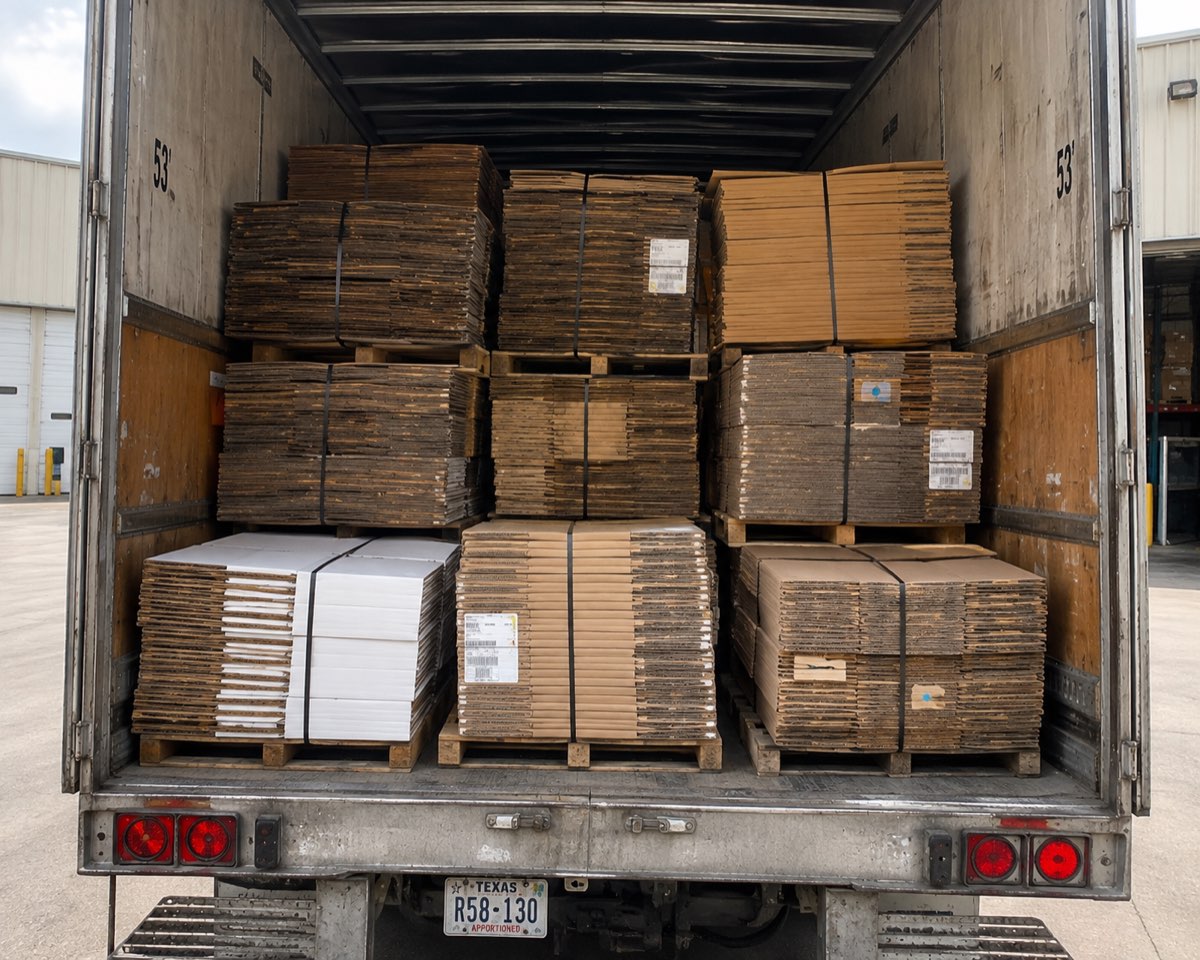
Rear view of a loaded box truck holding banded bundles of knocked-down boxes and assembled bins
Load-locked and banded. Corrugated that slides in transit arrives crushed.
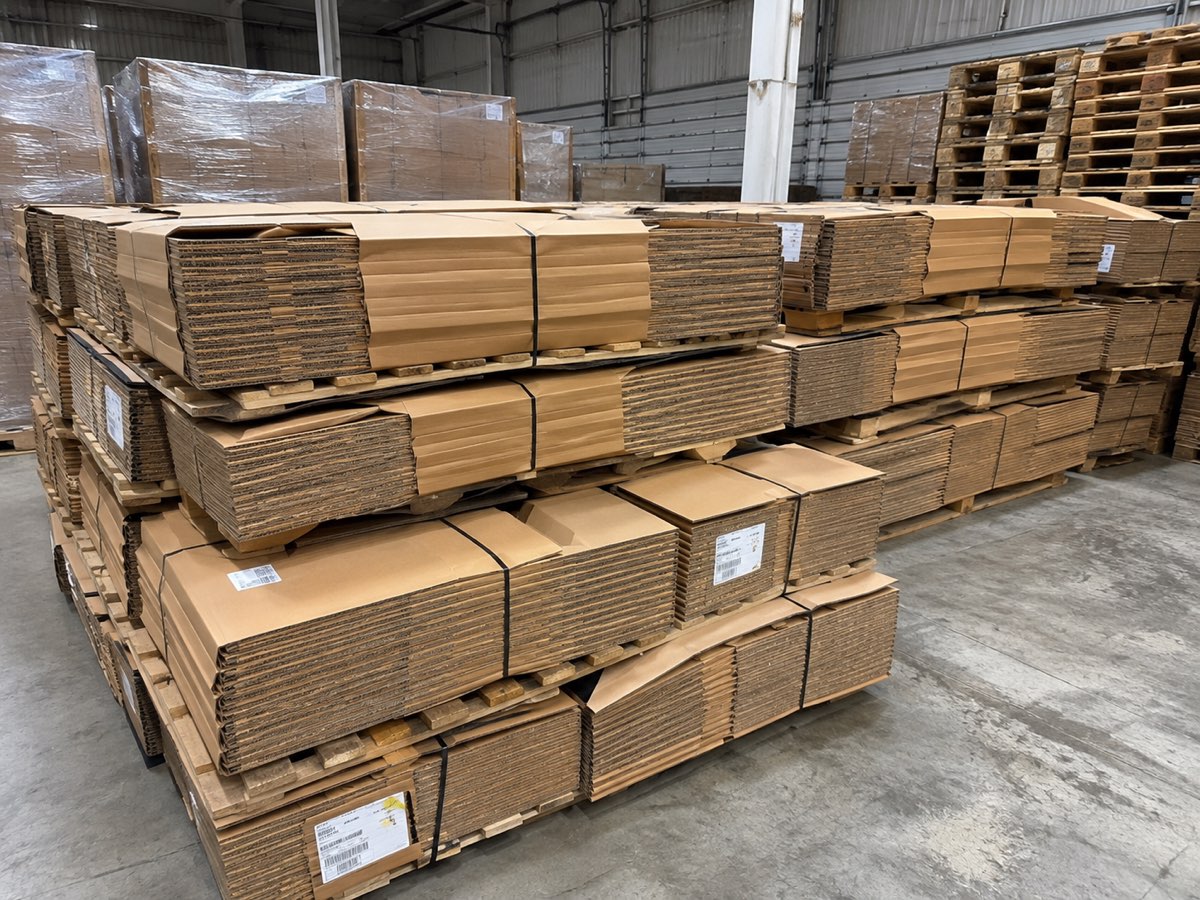
Knocked-down corrugated boxes banded into flat bundles and stacked on pallets
Knocked down and banded. Roughly four times as many per trailer as assembled.
What this post covers
  1. 1. Slab wicking
  2. 2. Condensation on cold loads
  3. 3. Dock door humidity exchange
  4. 4. Wash-down and floor cleaning
  5. The afternoon audit
Key takeaway

Corrugated gets wet in dry buildings through four mechanisms: slab wicking from concrete, condensation on cold loads brought into warm humid air, humidity exchange at dock doors, and floor wash-down running under pallets. None involve a leak, and all four are found by walking the building rather than reading a hygrometer.

Category
Operations
Published
June 10, 2025
Written by
Marisol Vega, grading line lead

When a customer's returns start grading badly for moisture, the first response is always that the building is dry and there are no leaks. Both things are usually true. Here are the four mechanisms that do not involve a leak.

1. Slab wicking

Concrete is porous and sits on ground that holds water. Moisture moves up through the slab continuously, and a box set directly on it is in contact with a surface that is quietly damp even when it looks and feels dry.

How to find it: tape a square foot of clear plastic sheet to the slab, sealed on all four edges, and leave it overnight. Condensation underneath in the morning means the slab is passing moisture. Do this in several places — a slab is not uniform, and the corner by the old loading area is often the worst.

The fix is a pallet, always, without exception. It is the cheapest single improvement available in any warehouse.

2. Condensation on cold loads

A pallet coming out of a cooler, or off a refrigerated trailer, or in from a cold night, is below the dew point of the warehouse air. Water condenses on it exactly as it does on a glass of iced tea in July, and it condenses on the boxes as well as on the product.

How to find it: look for water rings on the floor under staging positions near the cold dock, and boxes with damp bottoms and dry tops. That signature is condensation, not a leak.

The fix is dwell time and air movement: let loads temper in a staging area with fans before they go into storage, and do not wrap them tight while they are still cold.

3. Dock door humidity exchange

Every time a door opens in August, the building exchanges conditioned air for Gulf Coast air. In a busy dock the air within thirty feet of the doors is essentially outdoor air all day, and the boxes stored there are equilibrating with it.

How to find it: put a cheap hygrometer at the door, one in the middle of the building and one at the back. If the spread is more than about 15 points, your door zone is not the same building as your storage zone.

The fix is zoning: nothing stores within the door zone. Staging yes, storage no. Lids on anything that must sit there.

This is why we tell customers not to judge a box by where it was made but by where it was kept. The same delivery, half stored at the back and half by the door, will return in two visibly different conditions three months later.

4. Wash-down and floor cleaning

Scrubbers and hoses put water on the floor, and water runs. It runs under pallets, sits in the low spots and is invisible until somebody lifts a pallet and finds the bottom course ruined.

How to find it: walk the building right after cleaning and look at where water pools. Every warehouse floor has low spots; almost nobody has mapped theirs.

The fix is sequencing and elevation: clean when storage areas are clear, and keep corrugated storage off the floor path entirely.

The afternoon audit

  1. Three hygrometers: door, middle, back. Read them over a week.
  2. Plastic sheet slab test in four locations overnight.
  3. Walk the floor immediately after wash-down and mark the pools.
  4. Lift the bottom course on five random pallets and look underneath.
  5. Check for tide lines on stored stock — a tide line means it already happened.

That is one afternoon and it usually finds the problem. In the twenty or so of these we have walked with customers, it has been slab wicking or door zoning almost every time, and it has never once been the roof anybody was worried about.

#moisture#storage#diagnosis
Terms used above
ECT
Edge Crush Test. Pounds per linear inch a board edge withstands before buckling. The best single predictor of stacking performance.
Tide line
A wavy discoloured band showing a box stood in water. Permanent strength loss even after drying.

All 37 terms in the glossary →

About the author

Marisol VegaGrading line lead

Written on the yard at 1050 E Richey Rd, Houston. Everyone who writes here works the grading line, the baler, the routes or the quote desk — there are no guest posts and nothing on this blog is syndicated.


← Older

Labelling and tracking boxes in a reusable pool without a software project

Newer →

Reading a scale ticket, and what a vague one is hiding

Ready to move some boxes?

Send the form once. We answer in writing with grades, quantities, sizes and freight — no phone tag, because we don't even have a phone number.

Quick reference

Every number on this site, on one screen

The numbers we get asked for most

Standard size
48" × 40" × 36"
Standard volume
40 cu ft nominal
Usable volume
80–85% of nominal
Capacity range
900 – 4,500 lb
Per 53′ trailer, KD
≈ 480 boxes
Per 53′ assembled
26 pallet positions
Overhang penalty
≈ 20% per inch
Humidity at 90% RH
≈ 50% strength
Trips per box
3–6 when handled well
New box CO₂e
≈ 13 lb
Reuse cycle CO₂e
≈ 1.2 lb
OCC per 53′ trailer
≈ 20 tons

Stocked sizes, capacities and truckload counts

Inside dimensionsVolumeCapacityPer 53′ KDStock
48″ × 40″ × 3640 cu ft1,200 – 2,800 lb480Deep stock
48″ × 40″ × 3033.3 cu ft1,000 – 2,000 lb540Deep stock
48″ × 40″ × 2426.7 cu ft900 – 1,800 lb600Regular stock
48″ × 40″ × 4246.7 cu ft1,800 – 3,000 lb420Regular stock
48″ × 40″ × 4853.3 cu ft2,500 – 4,000 lb360Regular stock
40″ × 48″ × 4550 cu ft2,400 – 3,400 lb390Seasonal
41″ × 28″ × 2516.6 cu ft700 – 1,400 lb900Regular stock
30″ × 30″ × 3015.6 cu ft500 – 900 lb1100Regular stock
45″ × 30″ × 4535.2 cu ft1,500 – 2,200 lb560Seasonal
47″ × 38″ × 4445.5 cu ft2,000 – 3,000 lb400Seasonal
48″ × 48″ × 4053.3 cu ft2,800 – 4,500 lb320Made to order
48″ × 40″ × 4044.4 cu ft2,500 – 4,000 lb400Regular stock

Inside dimensions. Outside runs ½″ to 1½″ larger per dimension depending on wall count — use OD for racking and trailer clearances. Full size chart →

Wall count and load ratings

WallsStatic loadStackTypical ECT
2-wall1,000–1,200 lb2 high48–61 lb/in
3-wall (tri-wall)1,800–2,000 lb2–3 high71–82 lb/in
4-wall2,500–3,000 lb3 high90–110 lb/in
5-wall4,000 lb+3–4 high120+ lb/in

Ratings assume dry, aligned, fully supported, short duration. Derating explained →

Grades, at a glance

GradeConditionTrips left
1AStraight from the corrugator, unused, printed or plain.4–6 trips typical
AOne fill, clean, no repairs, no cuts. The sweet spot.3–5 trips typical
BTwo or three uses. Up to two clean repairs. Structurally honest.2–3 trips typical
CWorking boxes. Cosmetically rough, structurally usable, cheap.1–2 trips typical
SCRAPEnd of life as a container. Beginning of life as fiber.Reborn as new liner within weeks

Every pass/fail threshold →

Derating factors — apply all that fit, multiplied

ConditionFactorWhy
Storage under a month×1.0No creep adjustment needed
One to six months loaded×1.4Corrugated creeps under sustained load
Over six months loaded×1.6Long-term storage
Dry warehouse×1.15Mild humidity exposure
Open dock, no A/C×1.3Most of Houston, most of the year
Outdoors or cooler×1.5Needs a lid as well

Required load = full box weight × (stack − 1) × creep × humidity. Run it automatically →

Service area and turnaround

AreaTurnaroundRegion
HoustonSame day, most ZIPsHarris County
Pasadena & Deer ParkSame dayShip Channel East
Conroe & The WoodlandsSame dayMontgomery County
Beaumont & Port ArthurNext day, scheduled routesGolden Triangle
Dallas–Fort WorthScheduled backhaul lanesNorth Texas
San Antonio & AustinScheduled lanes, 2–4 daysI-35 Corridor
Yard
1050 E Richey Rd, Houston, TX 77073
Monday – Friday
7:00 AM – 5:00 PM CT
Saturday
8:00 AM – 12:00 PM CT
Sunday
Closed
Telephone
None — every quote is issued in writing
Quote turnaround
One business day